Monday, 27 April 2026

Oh, shiny!

I am easily distracted. Not in a doom scrolling/cat video sort of a way, more some shiny and new creativity catches my attention. I think we all are at least to some extent - my fascination for new things/the unknown comes from a desire to understand everything. Case in point this very blog. I created it in 2008 born out of my obsession with fingerstyle guitar arrangements. But it was immediately filled with anything that had some grounding in music.

Currently there is plenty of shiny things around me - mixing, AI, recording - but underneath are still the fingerstyle arrangements. When I sit here at the computer, my custom electric guitar is hanging right behind me and if I've heard a song or had an idea I will grab it and hash something out. Further, I've learnt that if I spend so much as even half an hour hacking out a song, I need to type it up into Musescore, otherwise the next shiny thing will take over, my thoughts are lost and maybe years later it will be shiny again, I'd already had a crack at that song but there is no documentation and I'm almost starting from afresh.

For example, looking at my arrangements folder, I can see quite a number of arrangements unreleased. Don't get me wrong - there are a heap that are released! I learnt many years ago that you need to finish things, even if they aren't perfect. Just ship it - the next ones will be better. It needs to be to a certain level of quality and completeness though - I don't throw half cooked ideas out there as if they were baked, iced and ready to be served.

So - my most recent incomplete arrangements:

  • Pink Floyd - Learning To Fly. It's a great song underneath, it meets the criteria of being simple enough - intuitive chords and melody - but with some nice flavours/textualisations that makes it interesting and engrossing. I can't decide whether to keep the bassline rolling like it is in Pulse or keep it laid back and relaxed.
  • Supertramp - Give a Little Bit. Love the rhythm and the weird "chord progression get reversed" feel. Such a fun song to play and a positive vibe. I need to nail down the final arrangement, I have played this out a few times now.
  • Dexys Midnight Runners - Come on Eileen. Fun, but quite difficult. Lots of chords that is hard to fit the melody in, hard to not play it too fast. Been sitting on that for ages simply becuase it is so difficuly.
  • Gorillaz - 19-2000. Iconic. Weird. Challenging. Love it. Difficult to play. I need to simplify it to keep the groove and feel...in fact just then, looking at it, holding my guitar, I just resolved a tricky high melody into a bass groove. Simpler, but holds the same feel. Nice. Shiny.
  • The Beatles - Blackbird. Yes, been playing this forever as just the guitar part, but then introducing the melody, the problem is the verse melody fits really nicely but a fifth down, but the chorus doesn't work a fifth down. Not idea how to resolve, have tried many ideas, have looked at others play this, still don't know what to do. Sits on the backburner. I play it out sometimes and just cheat through the chorus by not playing the melody.
  • Metallica - Enter Sandman. I've basically arranged this in my head and play it out regularly, haven't tabbed it.  Pretty easy and super effective - a crowd pleaser.

Two layers of shiny going on here - first - arranging one song and not finishing it and being distracted by the next song - second - being distracted with mixing worship music/AI to automate and simplify processes/building guitars and basses/so many other tricks and hacks to thing about!

Oh, there is somethign shiny over there, I'll be back!

Note: I still don't know how I feel about AI pictures. They are quirky and fun and pull together ideas. But all built on stolen photos and art. Don't like AI music. Do like hacky AI code for tools. Don't like AI algorithms vomiting confirmation bias back at me. Do like AI as an intial research too. I could go on - but it's early days of AI and I'm still deciding where I stand. Today I felt like an AI picture. Sorry to those offended.

Saturday, 11 April 2026

More vibe coding - song analysis

I am fascinated by the happenings in the LLM/Chatbot/"AI" landscape. I studied an "AI" unit at Uni more than 30 years ago, we called it "Artificial Neural Networks" in those days, but the underlying premise remains. I'm sure the tech is WAY more complicated than the simple models and training data we used. Heh, for my final year project I wrote a program in C, in DOS, that was running on a "luggable" computer (not quite a laptop, but a computer with battery you could carry around and use), that had a sound interface and a microphone. There was a small database of words, students would walk around with the computer and get volunteers to say the words that appeared on the screen and it would capture the audio - to be used for training data. I managed to put a pretty oscilloscope graphic on the screen as well - to make it fun for the person talking - as they pressed the space bar, said the word, pressed the space bar for the next word. After twenty or so words it would thank them and save all the sound files to folders to be later used as training and test data for speech to text. Very early stuff.

Anyway, it's fun to see it have come so far.

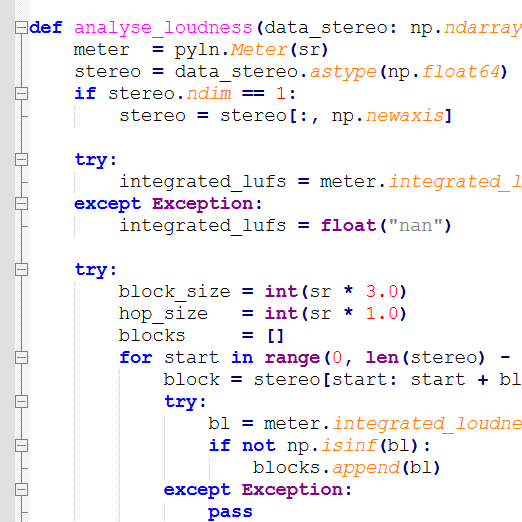
My most recent vibe code, with Claude who is my current favourite vibe coding chatbot, "we" wrote a python script to analyse music. Let me explain.

I have been mixing songs from my local church for a few years now, it's such a great way of practising and improving. Both as a musician and as a mixer/producer of a mixed song. I have mixed more than 60 songs over the last two years and I thought I'd take my favourite 12 from 2025 and make a playlist. But each mix has a different feel, as my ear developed, as my skills developed, so the 12 songs across 2025 have quite a different feel, even though they are all similar in style. Sure, there are differences - we aren't playing the same song over and over! - but I felt that as an "album" of 12 songs there should be a certain level of consistency.

I think you know where this is going

A basic consistency check is your LUFs and LRA. You don't want to be constantly turning the volume knob up and down between songs, or even within songs - so an overall perceived loudness (LUFs) and a measure of how much dynamics there are in a song (LRA) is important both for the listener and for a streaming service. Streaming services will adjust your loudness if you don't hit their metric.

In Reaper DAW I can easily track LUFs and LRA - but I was interested if I could get other sonic characteristics as a metric for comparison in Reaper.

In typical Chatbot style there was lots of talk about integrating various sonic libraries into Reaper (it has great programmability) blah blah, but chatbots just don't think outside the box. When it was talking about calling some python external to Reaper I said - "can we just do all this outside of Reaper?" and the answer was basically "yes that would be easy." Sheesh.

Suffice to say I now have an interesting python script that analyses a group of songs for an interesting range of metrics, looking for outliers and suggesting what needs to be changed and how it can be changed.

So much going on there. First thoughts are "C'mon JAW, are you trying to make all music hit the same bland boring metric?" No. And a little bit yes. Who else here turns down the start of "Time" on Dark Side of the Moon because they don't need to have extremely loud alarm clocks scaring them. I get it, the artistry, the "scare me into action because every year is getting shorter", but I don't need it on the 100th, 1000th listen. Or the first whalesong note in "Echos".

So I'm going to say yes, the LUFs should be close to each other (especially since the streamers will change them if you don't behave yourself) and the dynamics shouldn't be crazy wide. You don't want a listener turning up a song at the start because it is a quiet guitar intro only to turn it down again when the verse kicks in. At the same time you don't want your song to be so compressed that there is no dynamics at all (I was guilty of that on a few).

However for spectral data broken into bands, Sub - Bass - LoMid - Mid - Presence - Air, I do feel like there should be a certain amount of homogeneity across the board and yes, I did tweak some outliers. Frequency rolloff point at 85% is also another interesting metric. I don't want there to be some songs that sound like an AM radio and some that sound like you are standing outside of a rave party. Particularly when the recordings are from the same venue, the same style of music and the same groups of musos appearing in the songs.

From a vibe coding point of view - it s so good to do, fun and super effective and efficient. From an art point of view - I like consistency, I like having my mixes compared with each other to see where I went a bit wild in places. I have templates and recurring processes, but I mix to the song so they are always going to get a different vibe. From an album point of view I think reeling in some of the outliers is a good idea.

If you want to try it out, get it here.