Sunday, 13 November 2022

Bass Nut


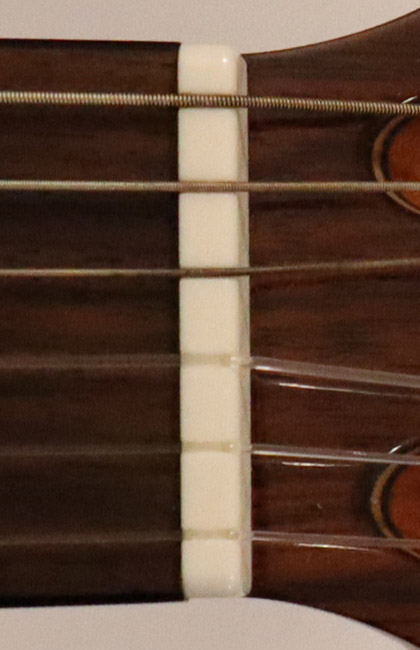
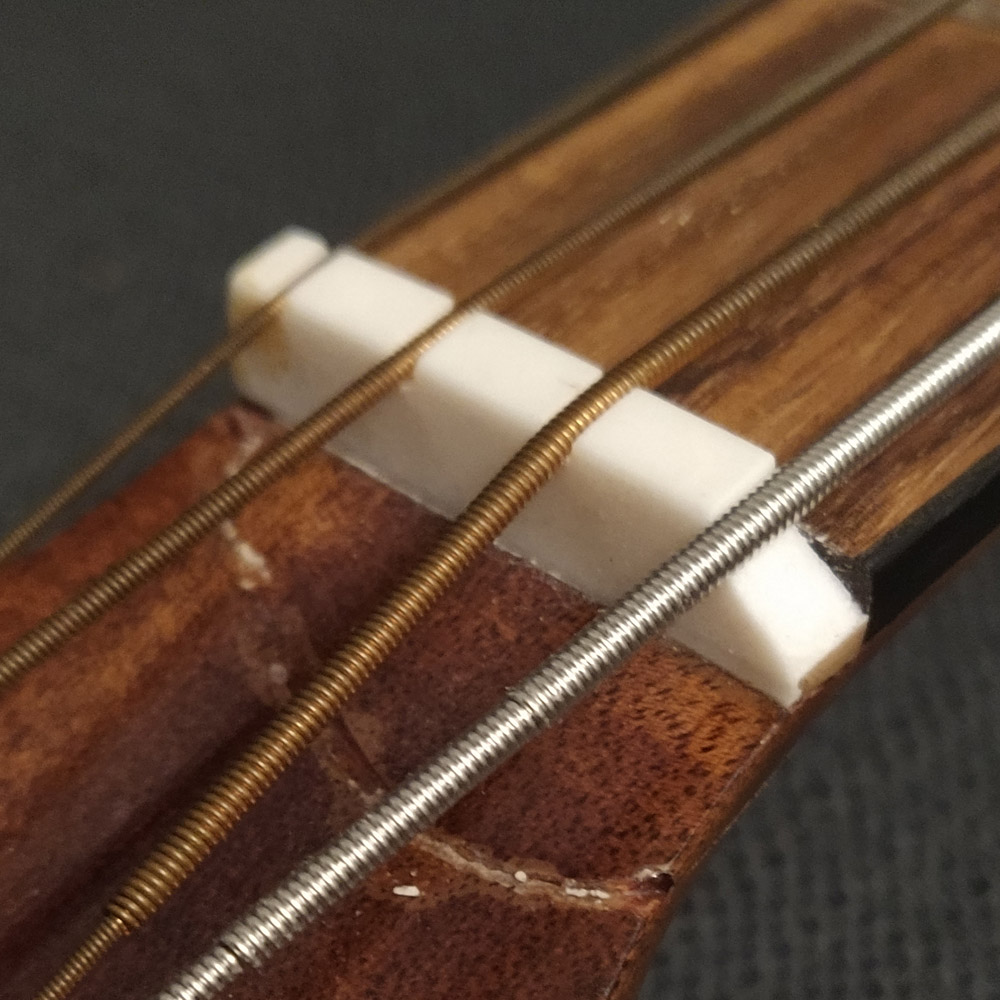
Broken nut

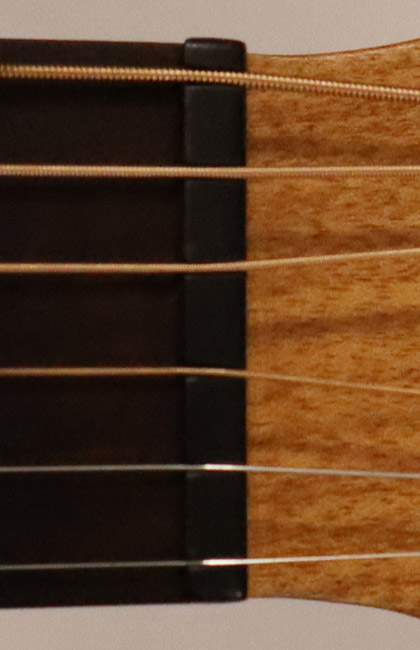
The school where I repair guitars has an acoustic bass, and somehow the nut was cracked. I don't know how you crack a nut, but the various guitar damage I have repaired over the years nothing surprises me anymore. In fact a few years ago the headstock on this acoustic bass was clean broken off. I wasn't game to fix that so it was professionally reattached, you can still see a bit of the scar in the photos. The repair on the back of the neck - where it counts - is smooth as, so good job whoever you are.

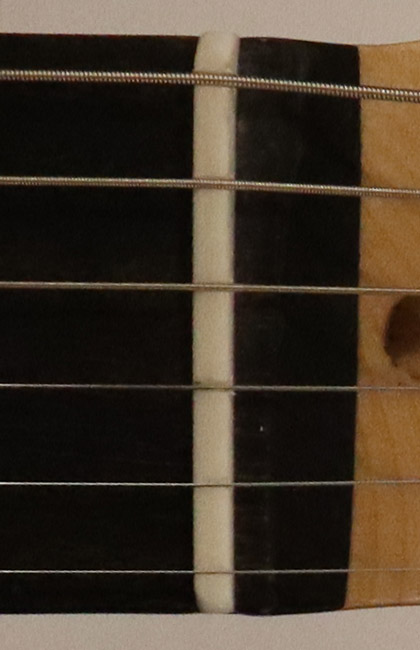
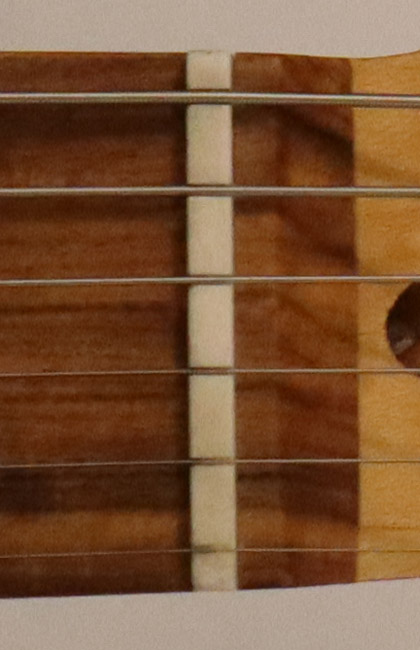
Since I had recently made a nut for my custom electric (I still need to remake that nut) I was in the nut making zone. I had already stocked up on bone blanks for nuts and saddles (they are cheap from Aliexpress), and I had one that was the right thickness it just needed to be cut down in width and the height made to match the fretboard curve. Once I had chiselled out the old nut, I cleaned the glue from the nut slot with a small file. I have an inexpensive set of jewellers files, it comes in handy.
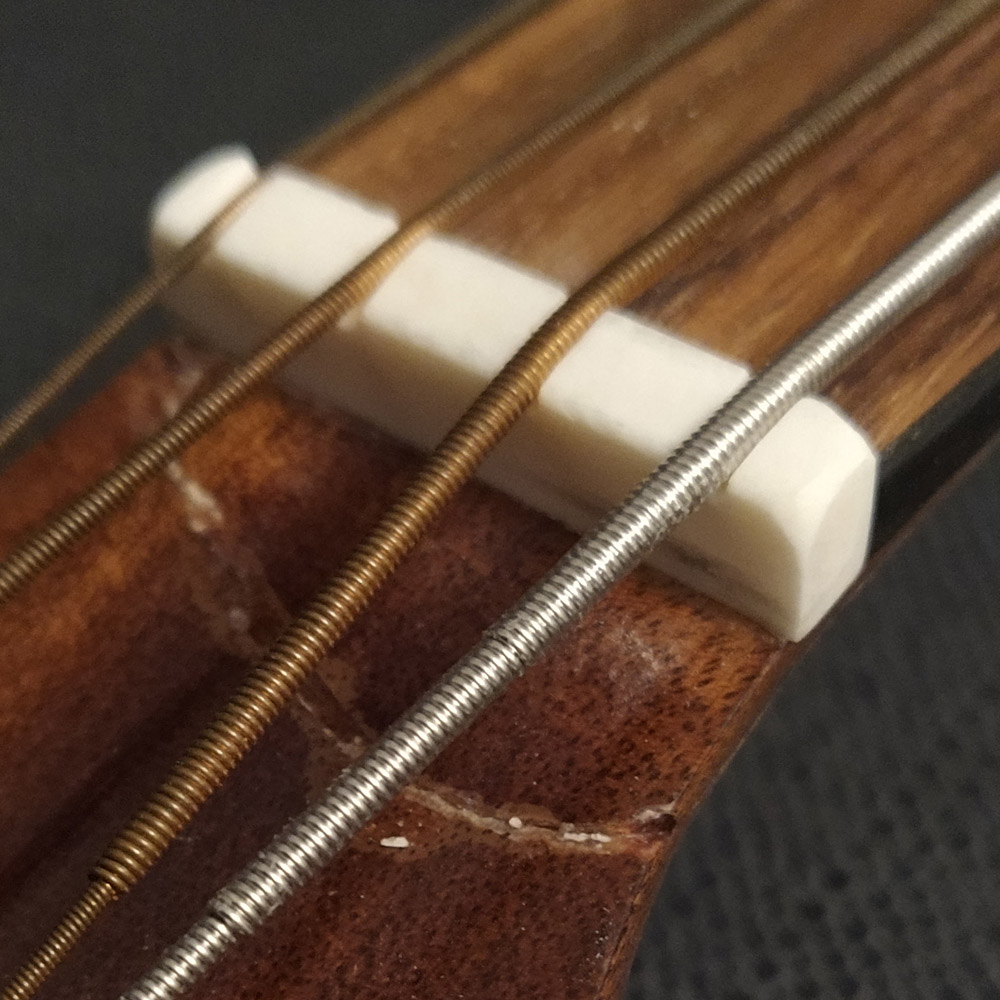

New remade nut

I use a cheap hobby vice to hold the nut while I file it, and I have a small piece of super flat marble stone for putting sheets of sandpaper on to get those perfectly flat edges. A good trick I saw on the internet for when you have something thin and you are trying to get the thin edge to 90° and flat - put another object with a perfect 90° edge on and run your thin edge piece back and forth on the sandpaper along the side of it.

Because bass strings are so fat, even the thickest guitar nut slot file I have is too thin...the jewellers files came in hand for that again. I based my nut spacing on the old nut which was already pretty good. I set the depth with the tap test - if you fret the 3rd and then tap on the string at the first fret there should be the tiniest gap, just enough to get a 'plink' as you tap. This makes a lot of sense to me - the string height at the nut should basically be the same as if there was another fret behind. If the string height is too high then you are bending the string too much when you fret the first, and you will hear that in the intonation, the open string will be in tune but the first fret will be sharp. I find I get this anyway, I fret too hard, so I'm pushing the string too far into the fret which sharpens it. It's nice however when you have the string height at the nut as low as possible to begin with.

If you file the slot too low, then the string is going to buzz on the first fret. That's not good. This what naturally happened to my main classical, after years of tuning - pulling the strings through the slots - they are actually worn down too far, and the open string buzzes.

Even with the nut slots as low as I could take them, this bass guitar is still pretty awful to play, the action is so high! I filed down the saddle which improved it but not enough. I adjusted the truss rod -  to the point the top string was starting to buzz a little and then backed it off a turn or two. The truss rod is only really for adjusting the neck relief not action, even though it does affect action. What the real problem with that guitar is - the neck angle.

To be honest, almost every guitar I come across that is more than say 20 years old has a slightly wrong neck angle. This makes sense - wood is not a dead piece of spring steel - over time , under constant force, wood is going to give a little. The physics of the situation is that most of the force is in the plane of the neck - so not pulling up - but there is enough force there for something to give over time. The give seems to be on the soundboard, which also makes sense. You end up having a very slight caving in deflection of the sound board between the neck and the sound hole. Guitar makers don't make a soundboard so rigid it will resist deflecting in - that would spoil the tone.

So, I would say most 20+ year old guitars need a neck reset. Basically detach the neck, cut some meat/new angle out of the heel, reattach. I've seen formulas on the internet for calculating the amount to remove, usually ends up being a millimetre or two. Once you glue it back on - the soundboard caving in/etc is still there - but now the neck is compensated for it. And you are back to blissful action again!

Generally the lower the action - given that there are no buzzes anywhere - the more playable the guitar is. You don't have to take you fretting fingers off and on so far as you refret. It's just a nicer experience. It feels like the guitar is working with you instead of against you. Even my main classical's action is starting to get a teensy bit high. It is a 2002 model, so that fits my 20+ theory. For now I'm going to stick with lower tension strings for a while.

But my oldest classical from the late 70's is quite far gone. I'd like to adjust it. I've seen an interesting hack where you cut through the heel with a thin saw, and then reglue and clamp the cut. You won't get the same perfect mating surface when you bend the heel in, so it will need to be the right type of glue to hold and fill, but the neck angle will have been readjusted. Maybe I'll buy an old cheap classical and practise on that first :-)

Saturday, 15 October 2022

String spacing


Classical
Nut width: 52.5mm
High E: 3.8mm
Low E: 4.6mm

Hybrid Nylon
Nut width: 47.7mm
High E: 4.8mm
Low E: 5.1mm

Acoustic
Nut width: 44.4mm
High E: 3.0mm
Low E: 2.7mm

Strat Copy
Nut width: 48.0mm
High E: 3.0mm
Low E: 3.6mm

Tele Copy
Nut width: 43.0mm
High E: 3.1mm
Low E: 3.4mm

Electric
Nut width: 41.9mm
High E: 3.1mm
Low E: 3.3mm

So after cutting a nut for the custom neck on the Strat Copy, and then played a tune I realised I didn't like the nut I had cut. The string heights were bad on the bass notes, so it sounds out of tune - which can be fixed -  but what I didn't like was the string spacing. The top E was too close to the side of the neck. I had cut it to a fairly general specification - 3.0mm - but it wasn't working for me.

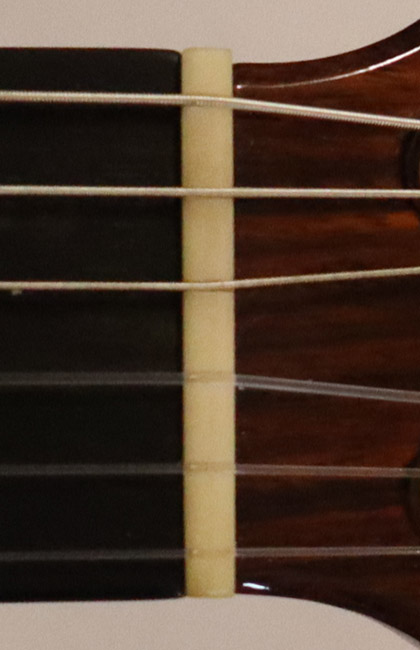
To find out why, I thought I would measure up the guitars I own, and how much I like or don't like their string spacing.

Quick note - the spacing is from the edge of the fretboard to the edge of the string, not to the centreline of the string.

I had hoped it was simply a "this is the distance that feels good" but it isn't.  It is a combination of several things, definitely the string gauge (nylon is much thicker than than steel for trebles!) probably string height off fretboard, probably neck radius, but other more subtle things like the radius of the front side edges of fretboard would make a difference.

It was a good exercise to measure though:

  • Classical is okay, the low E could be a tad closer to the edge and I'd be fine with that.
  • Hybrid Nylon is yuck! This exercise showed my why I stopped playing it years ago - the string spacing is gross!  You can even see it in the picture long before you take a measurement, both E's are too far away from the edge of the fretboard, which crams the strings up together.  I reckon if I cut another nut for this, it will completely change the way this guitar feels.
  • Acoustic is okay.  I reckon I could use a tiny bit more space from the side on the high E.  Surprisingly the very close low E string works out fine, especially when you are thumb fretting the bass. The advantage of a close distance to the edge of the fretboard means more distance available in string spacing, so you don't feel so cramped.
  • Strat Copy the high E is too close, low E is fine.
  • Tele Copy is fine, but the whole thing is too cramped with only a 43.0mm neck.
  • Electric is fine, but even more cramped than the Tele Copy.

So what do I think?  I'm estimating for a steel string (electric or acoustic) I would go with a 46mm neck, the high E at 3.5mm spacing, the low E at 3.0mm.  For a nylon, I'm estimating a 50mm neck with the high E at 3.5mm and the low E at 3.5mm.

This sure reinforces that the best way to know what you like is to play many guitars - I mean look at the differences in these string spacings I found! What suits me might not suit you - there is probably a cut for everyone - for instance somebody out there thought my hybrid nylon spacing was a good idea!

(Thinks wistfully about the $AUD4k Cole Clarke acoustic at Kosmic Music a few months back that just played so easily and beautifully - that must had the perfect string spacing for me.)

JAW

Monday, 26 September 2022

Custom Neck Installed

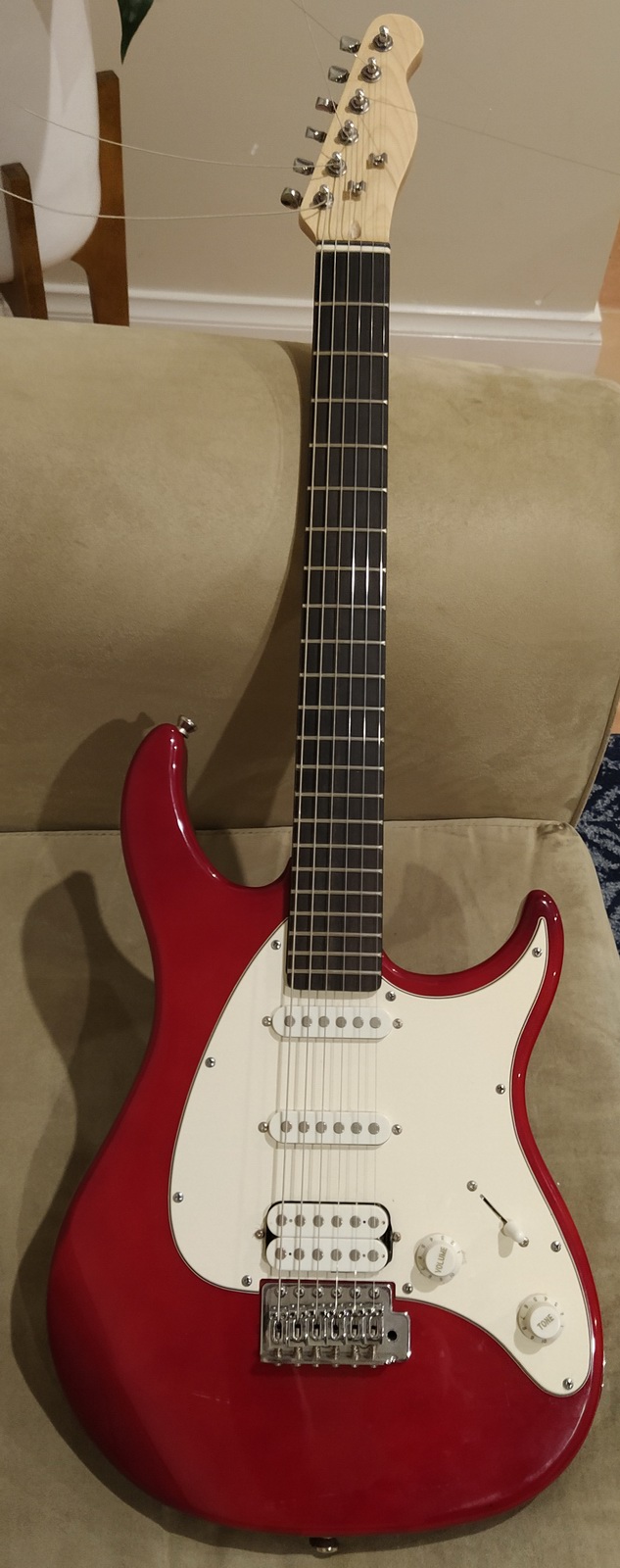
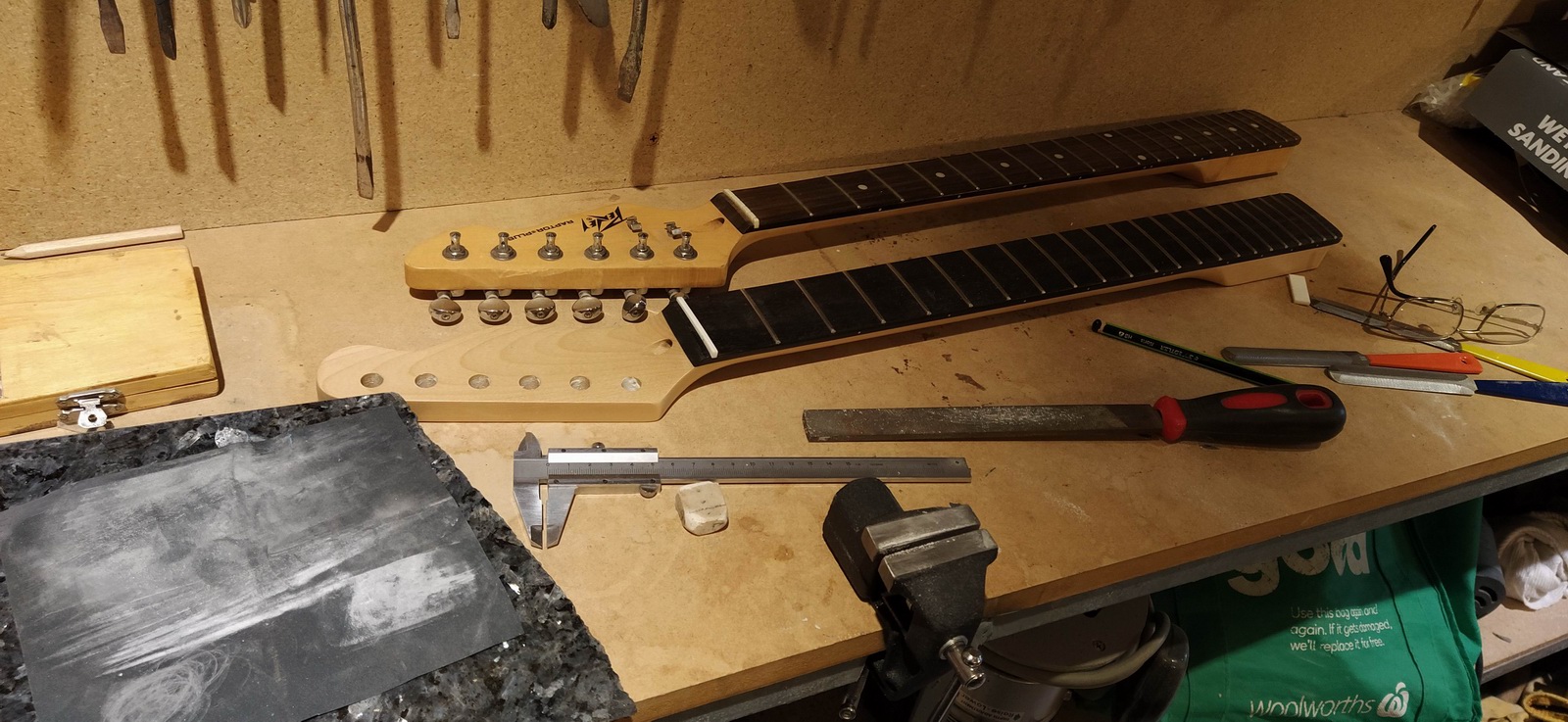
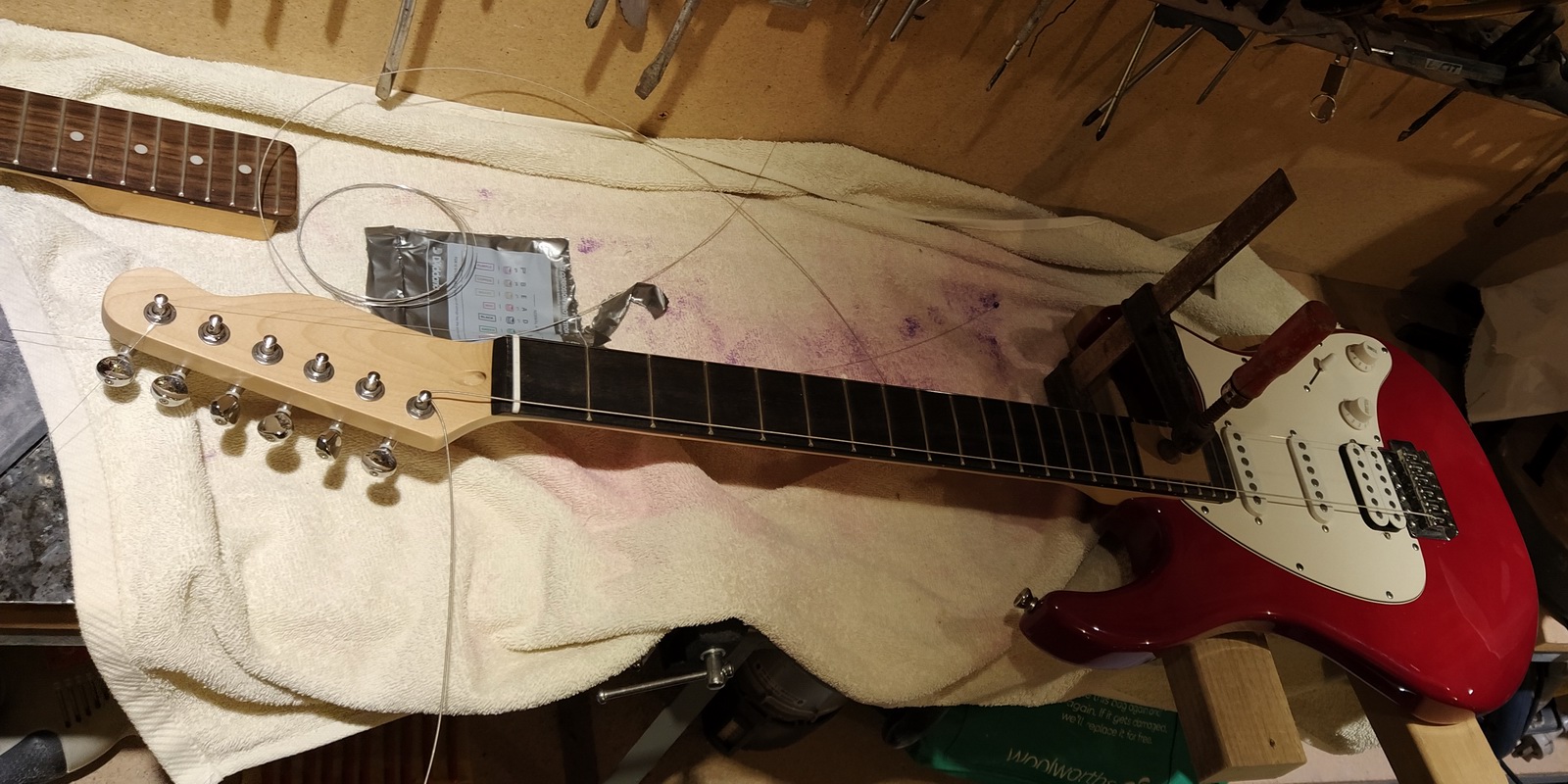
It finally happened, but not what I had planned... Back in March I bought an electric guitar, and then ordered a custom neck which arrived in May at which time I realised I had accidentally specified a Strat neck pocket instead of a Tele neck pocket.  While I _could_ have made it fit, I sat on my hands for a few months agonising over it, and then eventually snapped and bought a cheap second hand Strat copy from the pawn shop and installed the neck on that.

It's been an interesting exercise, I've learnt a lot.  Here is some of it!

Thanks again Leo Fender for standardising bolt on necks. The Strat copy I bought is the same neck as a real Strat and the same as what a bloke in China made with his bare hands. So it fits just fine. Fair enough, you changed the design between Strats (overhanding fretboard in the neck pocket) and Teles (flat ended in the neck pocket) to get an extra fret, but that really threw me!


Looks pretty! I like the classical guitar
fretboard and the overall simple clean lines

Handmaking the nut is not complicated, but it is tedious.  There are numerous tutorials on the interwebs so I don't need to write it up here, but I am going to talk more about spring spacing in another blog. By the time I had finished the nut I was already dissatisfied with it and I will be re-making it, but it will do for now. Shout out to Mr Manchester for his handy spacing calculator. When I make my next better one I will talk about it some more then.

Aligning the neck is nerve wracking.  Clamp the neck into the pocket, put on both E strings and then rotate it until the neck is square.  Then drill!  I reckon I was pretty close - I won't need to fill the holes and do it again.

Something as simple as drilling tiny screw holes to hold the machine heads in place.  This seems so obvious in hindsight - but screw on the machine heads first, wiggle them so they are perfectly lined up, then screw the little holes to lock them in place so they don't rotate. Not before! Streuth, I don't know what I was thinking - I was rushing it.

Enough talk about the build! What is it like to play? How does it sound?

Ha ha - I don't know yet!  I think I like it! I think I don't like it! I am going to remake the nut because the intonation for the low E is awful - the action is too high - and the top E needs to come in, it's too close to the edge of the fretboard.

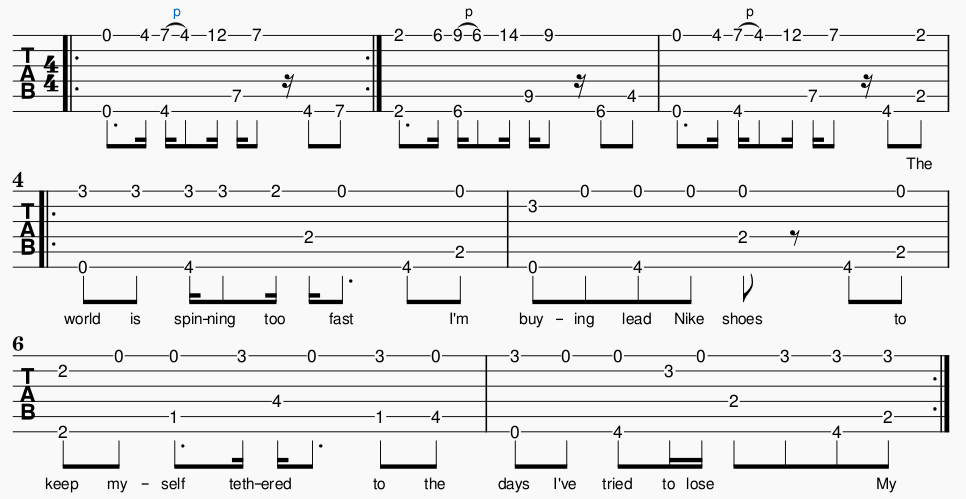
But it sounds like an electric guitar, so I took a moment to record something electric guitarish:

A shout out to my Patreons who help fund projects like this, and keep me supplied with fresh guitar strings 👍

Friday, 23 September 2022

Musescore Swings!

"If you gotta ask, you'll never know" - an old response to "What is swing?"

My hands found swing a long time ago - my brain had no idea what they were doing, but it sure felt groovy.

So when I started tackling arrangements with swing, I just couldn't get down what I was playing. I generally left the swing out with an instruction "just listen and play it like that". Occasionally the swing was so prominent and important I had to put it in the sheet. For example in 2019 I attempted to write out "Gold" by John Stewart as swung and got this:

Which I quickly abandoned because "something just isn't right, and wow, that's hard to type in."

But it's actually a good insight into how swing is notated - that above is text book "shuffle" - so I discovered. Secret let out - swing is delayed offbeats. Forcing the notation into triplets like I did above is a hard shuffle where the normal offbeat (the "and" note between main beats) is pushed out from 1/2 of the way to 2/3 of the way to the next note.

So when I recently took on "Horse With No Name" I once again came up against how to get that swing feel into Musescore. Because when I played the song I realised that my hands were playing swing. (How do they do that? How do they know when something swings, and when something doesn't? See opening sentence.)

So in my frustration I googled "Musescore swing". And what do you know, it's been there all this time! Musescore for the win!

In Musescore version 3, you actually just add text to a note, and that brings up a properties option, and in this case you can set the swing options. In version 4 it's right there in Format->Style->Score. And the people who write the Musescore software are clearly music geniuses - there is a percentage setting for the swing delay, so 50% means the offbeat note is "where it should be" out to 100% meaning the offbeat note is actually on the next beat (ha ha - let's call that "ultimate swing").

But let's not just talk about it, let's see it in action! Here are the first 4 bars "straight" to begin with and then "swing" at 60%, which feels about right.

Look, this is big improvement, but it is a strict rigid swing. I can hear that my hands actually vary the swing per offbeat as they go - for instance, "the" in "all the life" doesn't quite sound right in the above. I experimented with the swing setting after I did this, and discovered my hands actually swing "the" around 65% rather than 60%.

At least half of my arrangements need swing turned on I reckon - the text "Swing" at the top, and then when it plays back you hear the delayed offbeats.

"If you gotta ask, you'll never know" - but now we know, and luckily you never asked 🙂

JAW

Monday, 5 September 2022

What's happening September 2022

Quite a lot going on! Guitar repairs, new songs, playing out, where to start? Quick review, more details later!

  • "Fixed" the nut on the classical using the old supa glue and filler trick. The tips is to use bicarb soda as a filler - ie, make a "cement" of bicarb and superglue, and fill the slot. Then when it is hard, file it down. I thought that bicarb of soda sounded a bit wimpy, so I filed a bit of bone dust off a spare nut I had. Don't do this. The bone dust is nowhere near fine enough. While it made a good cement, and I was able to file it down, and now the buzz is all gone - it's so rough the string won't slide through when you are tuning. You have to yank it, and it twangs as it moves. No good. I will have to fix this properly.
  • I'm "playing out", kinda. I left my old classical guitar at work, some mornings if I'm early I'll play a few tunes before work, but on Fridays I would go to the park nearby and play for an hour lunch break. One Friday, it was raining and cold so I asked the security dudes if there was somewhere in the building I could play. They said to go into the break out room - it's quite a big room, there is a TV and couches and a kitchen and tables for people to have lunch at. Not normally very busy, so I sat in there and played for an hour. It's good practise, gotta keep all these songs fresh. A few people would stop and chat, but mostly quiet. But then last week it was getting busy, and people asking me if I'm doing this again next week. So, kinda playing out, kinda building an audience :-)
  • So I listened to Rick Bee-at-oh talking about famous songs that were only two chords. Rick is an interesting guy. Him and Mary Spender (an interesting lady) and another dude played them - one of them was "Horse With No Name" and I was, "No way, that's not just two chords". Went and listened to it. Yep, it's two chords. "That one will be easy to fingerstyle, shirley!" Well it is, and kinda addictive.
  • My eldest daughter, yes the one mentioned in the Canon in D, now 18, was in Sydney last month and while there saw Gorillaz in concert. Said it was a hoot. You know, I never realised that Damon was the lead singer of Blur. It all makes sense now. Anyway I looked at a bootleg video of the concert, and 19-2000 came on. I'd always liked that song. Thought - "I might be able to fingerstyle that". And I did. There is a lot of flying up and down the fretboard, so it's hard to be accurate. More practise required. But I reckon I've come up with a perky arrangement. Check it out!

JAW

Friday, 19 August 2022

Best Albums of All Time

I hinted in my last video about Best Albums of All Time. No - not best songs, but particularly best albums, from the days when albums used to be a thing. I generally don't post click bait Top-14-Best-Things-Everrr but the comment I made had me thinking a bit - what albums have had an effect on me over the course of my life, and what albums have stood the test of time, what are the ones I would play through right now? Let's find out, in my most favourite listenable order!


1. Pink Floyd - The Dark Side of the Moon - 1973 Phase 2 No surprise here, this has been with me since I found it in the late 80's. Only album I have put all songs to fingerstyle. I would still listen to this album once a month, sometimes more.

2. Pink Floyd - Wish You Were Here - 1975 Phase 2 Also no surprise, I discovered this album at the same time as Dark Side of the Moon. Not much more to say, I also listen to this album once a month. Great album.

3. Fleetwood Mac - Rumours - 1977 Phase 1 Every song stands on its own. Not a concept album like the previous two, but they all link together in such a great way. Well crafted, great album, my dad had me listening to it the moment it came out. Musically this album was very formative.

4. Ween - The Mollusk - 1997 Phase 3 I was put onto this by a friend when it came out, and I couldn't stop listening to it. Another concept album, and another album where each and every song stands on its own. Some dark themes in there, all very progressive rock. Caution - coarse language. Fun fact - the cover was created by Storm Thorgerson, who did a lot of art work for Pink Floyd.

5. Jeff Wayne - War of the Worlds - 1978 Phase 1 Another concept album, imagine that! A science fiction rock opera with recurring motifs and such varied characters. I loved the LP art - I would stare at those pictures as a kid while listening, I felt closer to "being a part of a story" through that music and art than any movie had ever done.

6. ELO - ELO's Greatest Hits - 1979 Phase 1 A collection of great songs, it was my dad that put this music in my head. Wonderful collection of Rock and Electronic perfect for my early teens. Strange that they released a "best of" so early on, there were several albums with great songs after this one. I like all the songs on this album, but it is missing "Don't Bring me Down" - that should have been there!

7. The Presidents of the United States of America - The Presidents of the United States of America - 1995 Phase 3 My wife and I would play this loudly while imbibing a few beverages. It fit perfectly in those early marriage years, just fun and catchy music.

8. Meatloaf - Bat out of Hell - 1977 Phase 1 Just classic rock. Another album my dad put into my head. Lots of emotion, lots of meaning. Each song great listening.

9. Tame Impala - Lonerism - 2012 Phase 3 A band from my home town, this is a great fusion of old school psychedelic rock, catchy pop rock, and interesting synth sounds. One or two songs are a little too far out there for me, but this is an album I can listen to from start to finish anytime. Interestingly, this is the "newest" album on my list, and yet it has an old school sound.

10. Metallica - And Justice for All - 1988 Phase 2 This dropped at the exact time I was ready for this. I didn't like hard heavy metal, but this more pop/rock flavour of heavy metal really worked for me. Full of political commentary which gelled with me at the time, these days not so much. But I could still sing you each song.

11. Guns N' Roses - Appetite for Destruction - 1987 Phase 2 As above, this was released at the right time in my life. One or two songs don't work for me quite as much as the rest, but its relentless beat, and like the above, political and personal commentary, just clicked for me at the time.

12. Jagged Little Pill - Alanis Morissette - 1995 Phase 3 My fondness for this album comes mostly via my wife. Well crafted, razor sharp lyrics - anger abounds - but tempered with the occasional sweeter side.

13. Iron Maiden - Powerslave - 1984 Phase 2 Discovered during the time I was enjoying the heavier side of music. Has a bit of a concept feel to it with its nod to ancient Egypt, the last two songs on the album I can still listen to all day.

14. America - History: America's Greatest Hits - 1975 Phase 1 Another album my dad forced into my brain. Some great songs.

15. Ottmar Liebert - Nouveau Flamenco - 1990 Phase 3 A quirky/wonderful instrumental album that was on constant repeat in a café where my wife and I often had tea and cake.  We had pretty much memorised the whole album before we asked what it was and bought it for ourselves.

16. U2 - The Joshua Tree - 1987 Phase 2 Probably the only album in my list here that is a celebrated "best album of all time" that got so much airplay I bought the album because it was just really good. Side one is a standout, side two doesn't standout but is quite good.


So I noticed that these albums came into my life over 3 broad periods of time:

  • Phase 1 - 5 albums - the 70's stuff my dad caused me to fall in love with when I was young;
  • Phase 2 - 6 albums - the stuff I found myself in my late teenage years when I was music focused;
  • Phase 3 - 5 albums - the albums I discovered from my 20's until now.

There are a few albums I have not listed on purpose, all great albums, but they exhaust me. Like Pink Floyd The Wall and The Final Cut. There should be at least one Beatles album there, but I find Beatles Albums are always a mixed bag - half brilliant songs, and half don't work for me. Even their greatest hits albums aren't 100% keepers. Same with Queen and Led Zeppelin. Pink Floyd Meddle was a close call, but I only really listen to two of the 5 songs. I was close to putting Midnight Oil Beds are Burning on the list, again, another album at just the right time for my musical sensibilities at the time, but I couldn't listen to the whole album.

👍 JAW

Wednesday, 27 July 2022

Nut

Quite a while ago, I noticed a bit of a buzz in my main classical guitar, the Esteve 1GR-11. I was quite convinced it was in the body, some wire or something from the pickup. It was very mild, on the D string, and only when I plucked really hard. I occasionally shook it, wiggled wires around when I changed strings, but it was not getting better, in fact it was slowly getting worse!


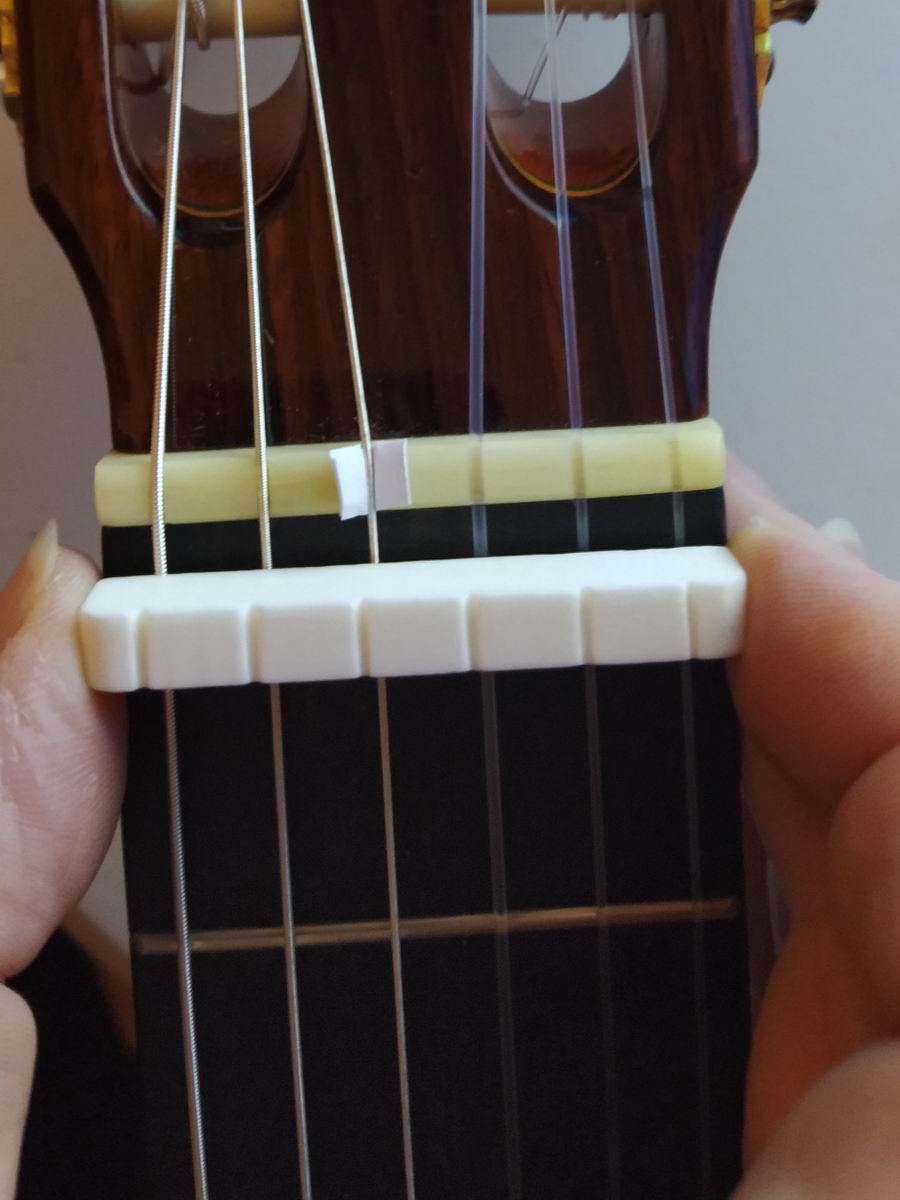
Test strip of paper and new nut
- will need some filing

When I recorded my most recent song, it was kinda bad, and was also now on the A string. So I really took to it properly this time, torch and mirror in the body and all.  I just couldn't see it.  In desperation I asked my wife - "where do you think this buzz is coming from? She immediately said "it's on the fretboard."

Yer what? No way! But, she was right. And to prove it to myself, I slipped a small square of paper, folded onto itself once, under the string on the nut.  And, with the few thou of extra distance to the fretboard, buzz went away.

It makes sense! The guitar was set up from the factory with nice low action at the nut and the saddle. But after years of tuning, dragging the rough wound string through the nut slot, of course it was going to wear material away.

No problem.  I ordered a bunch of bone nuts, you can get them from AliExpress pre-cut to almost the right size. And in they came. Now I just have to sit down with some sandpaper and a flat edge and slowly file it into place...