Showing posts with label Lessons and Practise. Show all posts

Wednesday, 19 April 2023

Tempo

A couple of weeks back someone on YouTube mentioned that I was a great guitarist and made really good arrangements, but my tempo is a serious weakness. He was very kind and apologetic about it - but I was grateful because it is true and I should do something about it.

This is where I insert my standard joke "I would use a metronome but I haven't found one yet that works properly."

Background: yes I had some group lessons when I was in primary school, but by the time I was around 11 I'd stopped having all lessons and I haven't had one since. When you teach yourself, you only concentrate on what interests you and you end up with big holes in your musicianship. One of my biggest shortcomings was that playing by myself I never bothered to develop an internal clock. If I had have played with others, or against a backing track or even metronome, I could have fixed this a long time ago.

Fast forward, I now play pretty regularly at my local church, and I tell you, it was SO HARD to begin with, I couldn't track a beat whatsoever! Even now, a few years on, if I start a song solo I am sweating bullets trying to hold a steady tempo. Once the drummer kicks in I'm not too bad at following these days.

All three of my kids play instruments, and I made sure they all played in ensembles, and they continued to for years. Their tempos are all thusly impeccable.

So after the friendly YouTube commenter nudge, I pulled out my phone and browsed up a metronome, and I played several songs... on beat! An actual metronome that works! To be fair, every now and then the metronome was slowing down, so I would also slow down to let it catch up, but really, it wasn't awful. A lot better than the maximum 30 seconds I've ever put up with a metronome before.

Moreso, I have been playing at a fixed tempo slower than how I would normally play, which is hard indeed! And I have played with that metronome at least 4 times over the past two weeks!

So to my fellow DIY musos out there - if you aren't going to play with a band, at least force yourself to play with a metronome or backing track. Easy to say, hard to do, but it is worth it 👍

Monday, 5 September 2022

What's happening September 2022

Quite a lot going on! Guitar repairs, new songs, playing out, where to start? Quick review, more details later!

  • "Fixed" the nut on the classical using the old supa glue and filler trick. The tips is to use bicarb soda as a filler - ie, make a "cement" of bicarb and superglue, and fill the slot. Then when it is hard, file it down. I thought that bicarb of soda sounded a bit wimpy, so I filed a bit of bone dust off a spare nut I had. Don't do this. The bone dust is nowhere near fine enough. While it made a good cement, and I was able to file it down, and now the buzz is all gone - it's so rough the string won't slide through when you are tuning. You have to yank it, and it twangs as it moves. No good. I will have to fix this properly.
  • I'm "playing out", kinda. I left my old classical guitar at work, some mornings if I'm early I'll play a few tunes before work, but on Fridays I would go to the park nearby and play for an hour lunch break. One Friday, it was raining and cold so I asked the security dudes if there was somewhere in the building I could play. They said to go into the break out room - it's quite a big room, there is a TV and couches and a kitchen and tables for people to have lunch at. Not normally very busy, so I sat in there and played for an hour. It's good practise, gotta keep all these songs fresh. A few people would stop and chat, but mostly quiet. But then last week it was getting busy, and people asking me if I'm doing this again next week. So, kinda playing out, kinda building an audience :-)
  • So I listened to Rick Bee-at-oh talking about famous songs that were only two chords. Rick is an interesting guy. Him and Mary Spender (an interesting lady) and another dude played them - one of them was "Horse With No Name" and I was, "No way, that's not just two chords". Went and listened to it. Yep, it's two chords. "That one will be easy to fingerstyle, shirley!" Well it is, and kinda addictive.
  • My eldest daughter, yes the one mentioned in the Canon in D, now 18, was in Sydney last month and while there saw Gorillaz in concert. Said it was a hoot. You know, I never realised that Damon was the lead singer of Blur. It all makes sense now. Anyway I looked at a bootleg video of the concert, and 19-2000 came on. I'd always liked that song. Thought - "I might be able to fingerstyle that". And I did. There is a lot of flying up and down the fretboard, so it's hard to be accurate. More practise required. But I reckon I've come up with a perky arrangement. Check it out!

JAW

Saturday, 23 April 2022

Was never going to try that again...but Paul Davids made me

Paul Davids is such a likeable guy.  Good musician, guitarist, video producer - he has a knack for how many words are too many - and are too few.  I've been watching him for years, right back to when he was in his old house...yeah, he started his youtube channel 4 years after me...  He has a quirky accent to boot.

Anyway, he talked about Never Going Back Again, the fantastic (Fleetwood Mac) Lindsey Buckingham fingerstyle piece. From one of the best albums of all time, "Rumours".  It's a complicated piece, and I'd meddled with it decades ago, but never really bothered to properly learn it.  It's one of those pieces that is already completely full, there's no room to add the melody on top - although Kelly Valleau did with a slightly modified tuning.

I haven't felt the need to learn something complete rote for a long time.  But Paul Davids put out a challenge, so I am learning it completely from the sheet.  Paul was nice enough to include tab portions on his video which I bashed into musescore, now it's just play play play until it gets into your head.  It is within my capabilities, and I can play all the phrases.  But there a big problem, which he did point out, and I also experienced while arranging and learning "The Great Gig in the Sky"...you have to hold strange bar chords for long times.

Now you can only really hold constant bar chords for a few minutes at a time, which isn't really enough time to get the Travis picking polyrhythm funky chord positions that the song is into your noggin.

The end result I had with "The Great Gig in the Sky" is play it every time you pick up the guitar, after a few months it will go in.  Luckily this song is repetition of the same and similar phrases, so there is less to learn and you can go through the whole thing more then once in a sitting.

So it shouldn't take me months 👍

Saturday, 2 January 2021

New year, new tutorial!

I started developing a "Tips and Tricks" for my fingerstyle guitar tabs a while back, and kept putting off finishing it, but with a bit of spare time over the holidays I knuckled down and got it done, yah!

Since slowly re-publishing my tabs in (the even more beautiful latest version) Musescore format and releasing them on Patreon, I knew that I needed a little primer video to get everyone started. While the tabs stand alone, and there is always the video I record of me playing them, there are a few tips and tricks I wanted to talk about.

Making videos like these, by yourself, is a big undertaking.  I reckon around 15 hours from start to finish for this little 10 minute video.  All those professional people out there, making amazing looking courses and tutorials - huge huge effort, well done.  I like making videos, but wow, this sort of video, just so much work.

I've also transcribed it, with tab bits, for people who prefer to read than watch a video.  Yah!

Nothing is new under the sun, but maybe there was something in here you'd never thought about!

I'm never happy with the end result when I record, well, any video, I can pick so many faults in them, but each time I make a video it's a little better than the last one. If I keep going, one day I might be good at it.  But for now, it's about looking after my Patreons, and this was something I really wanted them to have access to.

Go have a look! Enjoy! Here is the Transcript and watch the video below:


JAW

Tuesday, 31 October 2017

Relearning...

The other day I was practising through my Aussie rock setlist, keeping them fresh, and when the sax solo came up in INXS "Never Tear Us Apart" I said to my son "Your mum would love it if you could play this on your sax...do you know all these notes?" After a brief check, yes, it is within his capabilities. "It's E, then an Eb, then..." "Dad, can you just give me the score to look at?" I searched the internet and found a copy. It was a different key signature, but it was MuseScore format so a few clicks I transposed it, and did a quick test play though - hang on, that's not what I play...uh oh!

Sure enough, listening to the recording - I've been playing two notes in it wrong all these years! Hate that! So there's a question - shall I relearn those two notes or just accept that I'm not playing it right? Well anyone with a bit of OCD wouldn't be able to let that go, so I began relearning it.

Relearning is the worst! For starters, you once put effort in, and now, you have to apply even more effort to undo the old and put in the new. If it was just a melody it wouldn't seem like a big thing, but when it is bassline, mid fills and melody on top, you are relying on muscle memory quite a lot to keep it together. I found a resolve for the correct notes (required different fingers) and played the two affected bars over and over again. It started going into my brain, but it required immense concentration. I figure the two bars over and over again for a few more sittings a few days apart and I should be right.

Over the years I've changed bits and pieces in songs here and there, so it's not too bad modifying learnt music. In fact I will go so far as to say that forcing yourself to change bits and pieces in your songs is a good thing - it stops your back brain from doing _everything_ and gives your front brain some work. In songs which are second nature to me I will often slip melody notes an eigth of a beat forward, or backward - for starters it mixes up the song so it's not just the same verse, chorus, repeat; but it seems like a good thing to get the whole of your brain busy while playing.

...but not relearning a mistake.  Don't do that. Get it right before you commit to putting it into you brain...as a wise lady once told me, "Practise makes Permanent." :-)

JAW

Sunday, 17 September 2017

Teaching 101: Easy access

I'm not a guitar teacher...no wait, I am a guitar teacher!

This seems like a simple idea, like it's just about degrees of laziness, but until a student finds the deeper love and want to play guitar (indeed for anything that requires time and effort to achieve a goal) - then you have to remove blockers. Such as taking your guitar out of its bag after coming back from a lesson, that alone can block a student from practising.

(Learning something that is hard, that takes a long time, that takes a lot of work, that can be frustrating - it's a important undertaking more so than ever in our world of instant gratification. It's this good stuff that lasts and doesn't come easy, that's the stuff worth doing.)

I'm calling that the second most important thing to buy after you buy your instrument is a stand to put it on. They are so cheap too! I bought a heap of instrument stands for around $AUD15 online delivered to my door, and everyone in my house learning an instrument got one.

So at any time, the instrument is right there, and they can pick it up and play. Even 5 minutes a day gets those neurons synapsing and creates new behaviour.

Do it. Instrument stand. My youngest daughter is learning the cello and look it's right there in her room, waiting for her, at all times. And it's made a difference, she plays it regularly, often without prompting!

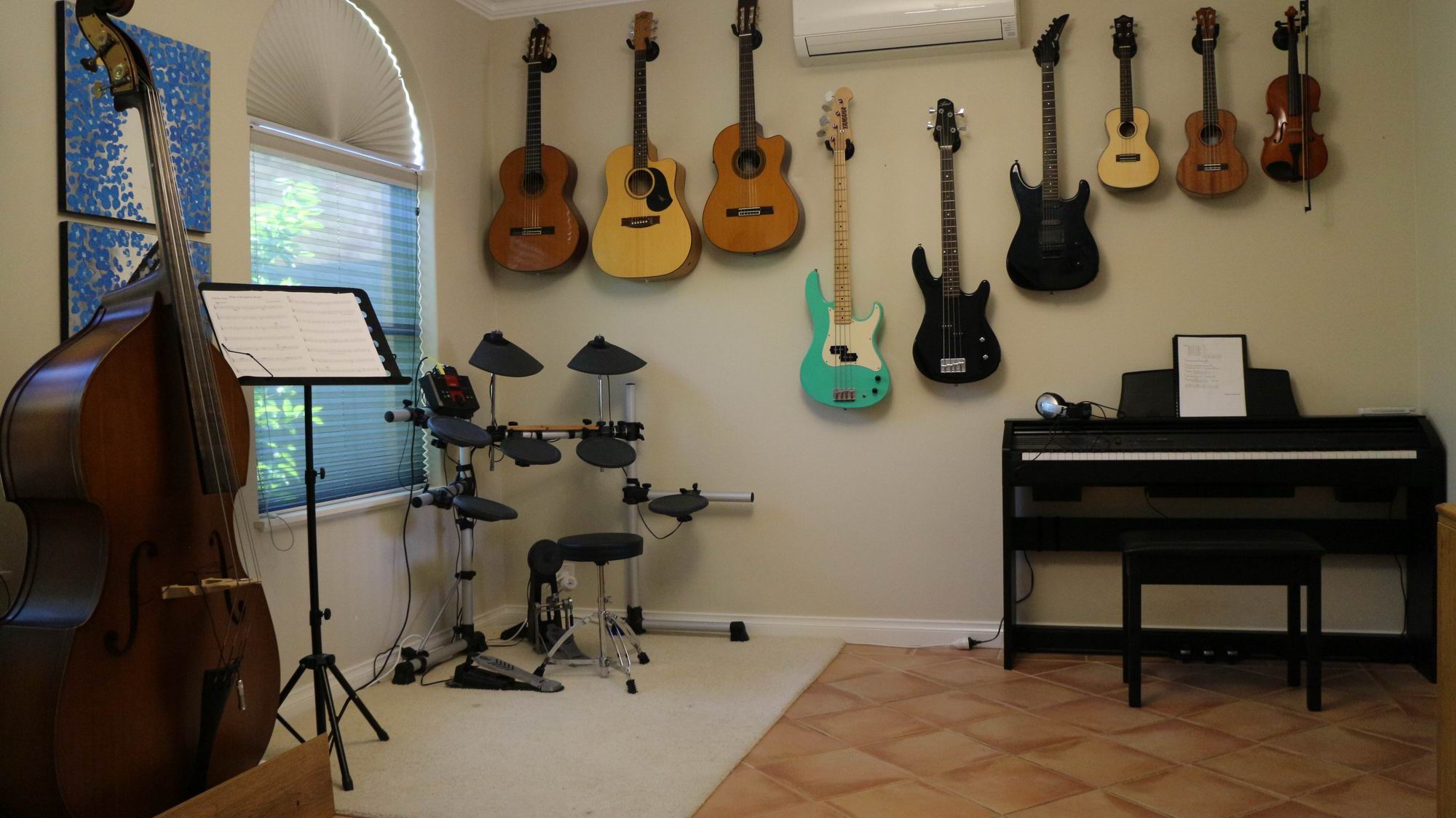
Now there are other options for easy access to your instrument. It's great to have one guitar on a stand somewhere handy, but when there are say 4 of them gathered into a room they take up a lot of space. I switched to wall mounting instruments, again, easily sourced online and very cheap. My wife likes the "look", they are still easy access, and the best part is you get floor space back. And how nice is it to sit in a calming room full of instruments. Good if you have an available room that is!

Thursday, 4 December 2014

Learn a lesson again. And again.

It's a familiar situation.  In all aspects of life.  But we do it to ourselves over and over again.

It started after having recorded footage for a new video on the weekend.  I'd put in a bit of effort - I recorded myself from various angles playing the same song so that I could splice pieces together from each angle.  To make a cool video.  It's a bit of an epic to compile the video as you could imagine, but one of the key issues is that each time you play it you won't play it at exactly the same speed.  One way around that is play to a beat, which makes my playing a bit stiff, the other way is to record a good clean audio track and compile the video carefully so that everything appears to synchronise.  You generally will only vary in speed slightly, so you can make 10-15 seconds worth of video appear to synchronise with the audio.

So I had the footage, which was recorded outdoors so none of the audio was clean enough, I needed the audio track.

One night during the week I had about two hours free to record the audio.  I sat down, set up the microphone and started playing. Take 1.  Take 2.  Take 3.  Take 4.  I wasn't liking any of them.  Change approach - record smaller sections of the song until I get each one bit right at a time, and then piece it together later.  I really dislike doing that, it is much better to get it all in one take.  It sounds more natural and is a lot less audio editing.

Looking back I was actually playing it nicely, I was after perfection, so nice wasn't good enough.  Because I had limited time, I put pressure on myself.  Each take I could feel my arm/hand muscles starting to clamp up - I wasn't relaxed - and each take was getting faster and faster tempo.  That generally happens to me when I'm not relaxed, I play faster.  It's a shame, because I call that a beginners trait, I should know better.  Still haven't got that beginners trait out of me after all these years.

And to top it all off, I am attacking the guitar.  Digging right in, getting a huge sound.  Sure, the guitar sounds full and crisp, but I know "it's not working."

"Whoa, it's like, music, man.  You've gotta let it flow, relax, and like, let it come to you man."  Perhaps I should have started the session with a tasty glass of liquid muscle relaxant.

And then, still playing too fast, too hard, in pieces rather than the full song, I cracked my index fingernail.  Diagonally across, right down to the base.  Cleaned it up with the clippers, basically nothing left.  Picked up the guitar, that crisp sound I get with a bit of fingernail was reduced to a mellow, kinda dull tone.

"Well that sucks."  I pack up guitar, it's all over.  Nothing recorded.  Feel tense and unsatisfied.  It will take about two weeks to grow fingernail out again.  I knew it wasn't working, but I put the pressure on myself to make it work.  And then it didn't work, and worse, resulted in a a setback.

Another lesson learnt.  One that I already knew.  Learn it again!

JAW

Monday, 25 November 2013

Play to your own style/laziness

I have mentioned in the past that tabs are good for you where I talked about how to digest and play a tab.  I've seen a couple of YouTube messages recently asking me about my latest tabs, and if they are all there, that some notes seemed to be missing, that sort of thing. My answer - "play to your own style/laziness".

On the other end of the scale, some people ask me why I don't include chords.  Mostly I just forget to add them and really I should always remember to add them, they are pretty important.  Not so much that it shows you what chords to strum (you can get chord/lyric sheets anywhere, much easier for following) - but again it helps you to play to your own style/laziness.

What do I mean "play to your own style/laziness"?

If you had a note-for-note tab transcription of a really stylish player like say Tommy Emmanuel (and I've seen those types of tabs) then you will notice be a lot of notes.  And even as you try to follow timings, and picking patterns, an attempt to perfectly emulate his style, you will struggle and it will take a long time.  Don't get me wrong, I'm not afraid of hard work, but tabs should be a guide.  Your ear will hear the subtleties and inflections when you listen to the recording, trying to track it note for note is not a good use of your time.

Maybe there will be little sections that a really accurate tab is important, but generally, you only need enough notes (or chords!) to get a feel for what is going on, and then develop it into something that you can play.  That is, into your style.

And your style will be as lazy as you want it to be.  If you are note-for-note learning then you are pushing your style out to match the arrangers style.  That's fine but it would be better to find the happy medium between playing the piece note-for-note and how you would play it if you arranged it yourself...that is, make it as lazy as you want it to be!

Drop notes, add notes, do everything as a tremolo, convert it to alternating bass.  Only play the bass note on beat 1.  Play a one fifth down bass note before each in-chord bass note.  Flick chord fragments on the 2nd and 4th beat.  Make it your own, take it (only) as far as you like.  I still believe, as a hobbyist,  it is better to be able to play 10 good pieces of music than 1 excellent piece of music.  Life is short, perfection is bad.  But don't be too lazy, always challenge yourself just a little bit, always move forward.

The other side of my "is the tab all there?" question is when I've only included the skeleton of the song.  I've noticed some songs only have maybe 20 bars of actual "information".  It might be a 5 minute song, but it is the same 20 bars of information played over and over, in different orders, with perhaps some subtle differences (that your ear will notice and you can improvise).  All you need is that 20 bars of information and you can work out the rest!  Imagine, just one piece of paper for a whole song!  You can make your own structure of verse/chorus/verse/chorus once you know what they are.  A bridge or a solo adds more information, but perhaps you don't even want to weigh yourself down with that.
 
It annoys me to see two pages of a tab where there are maybe 4 notes difference between them.  That sort of over-tabbing looks daunting when you first pick it up, and really, it is making stuff more complex than it needs be.  I'm all about simplification, about giving enough to get you started along the road, and letting you choose your own destination.  There will be times when you need to be 100% spoon fed, (in fact some of my tabs are indeed like that), but sometimes I'm going to give you a rod and teach you how to fish.  And sometimes, you should go make your own fishing rod...

JAW

Thursday, 15 August 2013

How have you kept playing guitar for so long?

A good question.  Although it doesn't surprise me when beginners give up playing guitar (another topic), it does surprise me that players who play well, and have done for a long time, give up.  Does it come down to character traits - applicable to more than just playing the guitar - commitment, and persistence?  I think it is more than just that.

There are many things in life that people will do passionately and they won't enjoy it in the slightest, it will be hard work, expensive, painful, but they carry on.  Why?  The satisfaction of completing something challenging.  Doing something not because it is easy, but because it is hard.  There's your commitment and persistence right there.  But hey, those guys who did play for ten years and then stopped, they must have had the commitment and persistence to get that far, right?

Habit.  Ah but aren't we all just creatures of habit?  Once you form a habit, it's hard to break it.  If you have a habit of playing the guitar, then you basically never stop.  And yet, they still do.

Priorities.  For sure, as life progresses you travel through different phases.  Some things are very important, then they aren't so important.  Apparently it takes six weeks to form a habit.  Well, when priorities change, it only takes six weeks to un-form a habit.

I'm going to throw opportunity into the mix.  If playing the guitar is a privilege - it's rare, you don't get to play as much as you would like - for whatever reason - then playing is a tantilising treat you eagerly wait for.  Being able to play as much as you want whenever you want will increase the risk of losing the sense of satisfaction...changing your priorities...and breaking the habit.

I think all these things play a part while traversing your guitar life, but there is something else.  And look, I believe once you are a player, and you've had a taste of all this, you will always be a player.  You might go a few years without playing, but something will come up again and you'll get back into it. That something is...delight.

Yeah, delight.  In all your opportunity, priorities, satisfaction and formed habit, it is delight that rises above it all.  Just when you think you've done it all, you've climbed every mountain, overcome every obsticle, something comes along and blows your mind.  You can't believe you could have possibly missed the song, the technique, the concept, the something - something that simply delights you and you just can't get enough.  You can't stop.  Shifting from delight to delight.

If you are constantly exposing yourself to new avenues of delight, the passion will stay with you.  This is with everything in life.  Seek out delight.  And delight doesn't mean amazement or awesomeness or some huge gratification.  It can mean a hammer-on where you used to to pluck the next note.  I could mean slipping in a 7th on the last beat of the bar instead of staying in the major chord.  Just enjoying a new song that you never even thought about before.

I think I may have just gone all new age hippy on you just then, but The World seems dissatisfied with you just smelling roses.  You aren't living if it's not Bigger and Better.  Well, bugger that :)

Speaking of which, here is my current delight.  Naudo played it years ago, I heard it on the radio last week, decided to transcribe (more or less) Naudo's version, and I'm delighted.  So many "Oh wow!" things that happens in this song, can't believe I didn't tackle it when I first heard Naudo play it.  It's a window into his playing (I can see how he has re-used phrases from other works I have transcribed before) and it's just a really nice song.

Badfinger's "Without You", made famous by Harry Nilssen, and later by Mariah Carey, but let's just stick with Naudos version :)

Apologies about the recording, it was made via my smartphone. And I'm still developing the song, I haven't committed it to muscle memory, and I'm not playing on my normal guitar, and blah blah blah...JAW "warts and all" Munji strikes again, enjoy.

Saturday, 20 August 2011

Video blog: More Stupid Girl

I kept going on Garbages "Stupid Girl", I more or less have it complete. Made a lessony type video for my mates, I'm still enjoying the song a lot. Sorry that the tab doesn't exactly seem to line up with what I'm playing in places, but I think you'll get the drift. Sorry to Nil - too much talking in this one. Melvin however, you are in luck!

If you don't know Garbage "Stupid Girl" you can watch it here: http://www.youtube.com/watch?v=1HBxUWSxcq8

Tuesday, 10 May 2011

Q&A: Alternating pick

I had an interesting email that I tried to best answer a few weeks back; it was out of my area of confidence - being specifically *not* about fingerstyle! - but I had a crack at it.  I thought it might be interesting to my fingerstyle mates here; and even better, some of my not *solely* fingerstyle mates might be able to offer up a better answer than I did! :)

---


Hi Jaw,

According to you, using a flat pick is not your forte :) but your experience should be able to assist me.

If I am going to learn alternate picking, should I not alternate pick all my notes/songs/scales etc ALWAYS anyway after that ? If alternate picking is so much more better/efficient why isnt it just the standard type of picking taught from the onset ? I clearly understand the benefits of alternating pick, but I am having a problem understanding why anyone would revert to "regular" picking if its inferior to alternate picking. So for example: Once I learn alternate picking and I am given 3 notes to play, I will simply alternate pick all over them, it will feel smoother/faster, why wouldn't I? What will I miss if I completely do away with "regular" picking ?

Sorry if it all sounds repetitive, its impossible to Google such a question and I'm just trying to make sure that I describe it well enough for you to understand my beginner dilemma!

Regards,
Greg

---
Greg, you sound just like an engineer! The best way of thinking of course :)

But when we put down our technical physics based ways, and have a go at thinking about what we are trying to achieve - sound, groove, style - alternating picking shouldn't always be performed. For instance, say you were playing just four bassnotes in a bar and you wanted to accentuate the same thumping sound; you would downstroke each one the same.

And if you were playing offbeat, playing notes on the "and" (one and two and...) they will want to have that "and" sound you'll get from upstroke.

I'm not suggesting that on beat is always downstroke and off beat is up, although it's probably a good starting point to help you "feel" what the groove is doing. I'm talking from more a rhythm style than lead style, but the message is similar.

Shredding for instance would probably be non-stop alternating, you need the speed - but even then I'd suggest that occasional downstroke notes would line up on beat.

I think if you close your eyes and feel the music, and put the mechanics out of you mind, you'll know where to downstroke and upstroke. That's really easy for me to say however with a lifetime of guitar mechanics behind me that I *can* do with my eyes closed, but I could have come along a lot faster if I got more into what I can only describe as "groove", where the music is coming from "you", not through a series of optimised efficient programmed movements :)

Hope you find something in that ethereal vauge gut reaction from this 30-years-in-guitar-still-leaning, who hasn't held a flat pick for more than five years :)

JAW

Tuesday, 8 February 2011

Fingerstyle "Time" by Pink Floyd progress lesson

Here's a little video primarily for Ryan but for anyone who is interested. "Time" by Pink Floyd played finger flicking :) I'm still not all that comfortable doing video "lessons", but like all things you just have to do it, get on with it, and eventually you'll get better at it.

It's about 10 minutes long, and no, I'm not actually singing in there, it's more like strangling a cat (that's why I play the guitar) :)


Yes, I'm still "developing" my skills as a lesson presenter, one of these days I will get around to posting proper lessons...watch this space!

2017 Update: Although this is not a lesson as such, I played through Dark Side of the Moon again. I also mumbled more about "Time" and some changes I've made over the years

JAW

Tuesday, 2 November 2010

Fingerstyle Database

Go straight to JAW's Fingerstyle Database!

Realised that there are now hundreds of great fingerstyle guitarists posting videos on youtube, but don't know how to find them? Have we got a solution for you! :)

Since a brief exchange of comments on this blog, Roman and I discussed creating a "fingerstyle database", which would contain all the fingerstyle guitarists that we have got something out of listening to, so that we could share our discoveries with others.

The criteria was simply fingerstyle guitarists actively posting videos that the average person would take something away with after listening to. That is a subjective point of contention - what I take away from listening and watching a fingerstyler won't be the same as you. Broad examples would be a fingerstyle guitarist producing their own arrangements - even if they aren't that great - because the next person might be inspired to take the work further. Someone playing a tremendous cover of someone else's arrangement, just for the pure listening enjoyment - that would also be a keeper.

However someone playing a poor video/audio/rendition cover of someone else's tab, well we'd have to say no. We want the database to be punchy, quick and full of great surprise findings - we don't want to wade through hundreds of players that although sure they can play a tune, they aren't adding value to us visiting them.

I'm sure it will be a point of contention, but I think you know what I mean, so let's see how it goes!

What does the database give us? Name, website (usually youtube because it is so prevalent, but doesn't have to be), the style of fingerstyle (on the left extreme is the nylon string classical player, on the right extreme is the percussive tappin' steel string player), whether they are an arranger, whether they have tabs, and a quick description.

What can you do? Everyone who visits can give a thumb up to a player! This way "the public can decide" who is the pick of bunch worth listening to. If you are really excited by this and would love to be a part of it, email me and I will make you an administrator - with the ability to add, edit or delete players.

Features? Aside from the aforementioned "public opinion" with thumbs, and administrator access if you'd love to be a moderator...well, you can sort any column by clicking on the column heading. There'll be a "new" icon next to any players that have been added in the past 90 days, so you only have to check four times a year to keep up :)

Now I'm not really a programmer; this is all hacky perl scripts and the database itself is an imitation XML text file, so the features are limited. On the plus side, if you have some great ideas that Roman and I didn't think of, and it doesn't require too much effort, I can probably hack it in!

Go there: JAW's Fingerstyle Database - feedback and bug reports appreciated!

JAW

Sunday, 19 September 2010

Happy Birthday!

A few weeks ago I did the same winery gig that I did last year, and something happened that I had planned for many years ago, but hadn't kept up with - it was someone's brithday and I got a request to play "Happy Birthday". I couldn't even remember the chords!

Basically if you ever play to an audience you need to keep "happy birthday" in your bag of tricks, because it will come up. Fear not, I dusted off some old notes, did a cross check with other tabs on the net (many had parts that I liked but none were enough by themselves...besides, nobody should ever play a tab exactly as someone else has written it! :))
                                 HAPPY BIRTHDAY

 3/4        C          G                     C
|---------|----------|----------|----------|----------|
|---------|-------1--|-0--------|-------3--|-1--------|
|-----0-0-|-2--0-----|-0----0-0-|-2--0-----|-0----0-0-|
|---------|----2-----|-0--------|-0--------|-2--------|
|---------|-3-----3--|----------|-2--------|-3----3---|
|---------|----------|-3----3---|-------3--|----------|

             F(b5) F     C     G     C                   ~~~~~
|-3--0-----|-------1-1-|-0--------|--8------|----------|------*|
|-1--1--1--|-0-----1-1-|-1--1--3--|--8------|----------|------*|
|-0--0-----|-2--2--2-2-|-0-----4--|--9------|-0--2--0--|-3----*|
|-2--------|-3---------|-------5--|-10------|----------|------*|
|-------3--|-----------|-3--------|-10------|----------|------*|
|----------|-1-----1-1-|-------3--|--8------|----------|------*|

Here, have a listen to me play it. It's short, mostly in chords, and easily remembered. Only two parts may cause you some frustration: in the first two bars I'm holding a C shape but I bend my second finger backwards to fret the A second fret third string. I do this sort of mini-barre quite often so it comes reasonably natural to me.

The F(b5) chord may throw you -  do it as and F barre chord but don't lay your first finger for the full bar, just fret the low 6, leave the top strings un-barred. Then clamp down the barre for the full F in the same measure.

The rest should be easy for a fingerstyler...don't worry about running up the fret board for the last G and C chord if you don't want to; as with all tabs, make them your own!

...oh and make sure you throw in the heavy vibrato on the end note of "And many more..." I love a bit of comedy in guitar playing, it's not easy to put comedy into guitar playing, so anywhere you can do it you should! :)

JAW

Thursday, 17 December 2009

Thumb Independence...huh?

Thumb independence; it is your key to "modern solo instrumental fingerstyle".

Okay, so you aren't into flatpicks, good for you :)  You have a fairly solid background in Classical style, even better!  You need to learn and master the following riff, an arrangement by Tommy Emmanuel from the Beatles song "Day Tripper".  Use right hand index and middle fingers on the top two strings, the thumb does all the bass line work.  If you don't yet have thumb independence then it will take you many hours over a few days to master - how can two bars be so hard? - you are about to make your brain work in a different way.  If you master it, then you don't need to read the rest of this blog, you will _understand_ thumb independence.
|-0---0---0---0---|-0---0----0----0---|
|-3---3---3---3---|-3---3----3----3---|
|-----------------|-------------------|
|-------------2p0-|-------4-------0h2-|
|-----------2-----|-----2-------2-----|
|-0-----3h4-------|-------------------|

Look; just the same as there is not really such a thing as muscle memory there is also not _really_ such a thing as thumb independence.  All you are doing is expanding your rhythm from a very basic one to more of a more complex polyrhythm style.

Normally as a classical player your thumb might play the first note in the bar and your fingers will then arpeggio or pattern pluck the rest of the bar, repeating for the next bar in a different chord.  Maybe there will be a second bass note, but essentially it is all on a regular beat.  It is when you thumb a bass note on an off beat you are performing "thumb independence".

Okay, I admit, true thumb independence _may_ exist.  As in, your thumb is doing something completely separate to your fingers.  An example would be playing the melody to Baa Baa Black Sheep with your fingers on the treble strings while thumbing the bassline of Peter Gunn at the same time.  Well no, that isn't really thumb independence you could train yourself to line up beats.  But if you played it through once; and then played it a second time but played the bassline *slower* than the melody - in fact you could play either the bassline or the treble at any speed relative to each other, chop and change sections out at will, then hallelujah, true thumb independence does exist and I will eat this blog.

Meantime, "thumb independence" will completely revolutionalise what you play and how you play, you just won't understand until you understand...understand?  This "thumb independence" I talk of is a learned polyrhythm; for example once you have mastered the above riff you now have a tool in your kit where you can strike an off beat bass note in a very specific situation.  Continue to learn more songs of that style and the more learned thumb independence patterns you will achieve.

Also - don't just consider thumb independence to be about the thumb, indeed the thumb might be playing a totally on beat pattern, your fingers may be playing the off beat!  Thumb independence simply means that what is happening on your fingers and thumb doesn't line up on a "normal"  beat.

My continuing strategy for achieving thumb independence is to very slowly bash into my brain a particularly tricky pattern, playing at ultra-slow tempo or even no-tempo, and force my fingers to learn the muscle memory required to perform the pattern.  Over time it will sink in and yet another thumb independence pattern is available in my toolkit.  It is very forced, difficult and almost unnatural; your thumb will tend to want to pick up on "normal" beats - indeed, it will fight with you.  Win the fight; and transform your sound from a very primitive western style rhythm to a creative and interesting polyrhythm!

JAW

Thursday, 20 November 2008

Loss of Cohesion

I was just messaging with a guy on youtube about "loss of cohesion"...you know, when you are playing a song, maybe one you know exceptionally well and have been playing it for 5 years, and still you'll be midway through and you completely lose the plot and basically have to stop and start again.  Possibly the most embarrassing thing you can do as a guitarist eh?

I don't think loss of cohesion can be prevented.  Guys like Tommy Emmanuel can simply launch into some default "recovering" improvised thing, then eventually get back on track and people will never even noticed he fluffed it.  I used to occasionally terminally brain fart and basically have to start over again but these days worst case is having to stop and replay from the last key section.  Most of the time if I fluff it I can sort of strum some nonsense and reconnect back to where I should be without dropping the beat, but it is still obvious that I've lost cohesion.  I've got a long way to go before I can fudge past it like The Greats can; I think that requires an extensive knowledge of music theory and being well practised in improvisation.

I think getting over losing cohesion isn't about practising to death note for note, it is more about learning what to do when you _do_ lose cohesion.  So, when practising if I lose cohesion I don't stop and restart, I keep going maybe strum the current chord or do some percussive slaps, at least keep a bass note alive, but keep on beat and meet up at the next key intersection.  For this reason if I am going to start playing a song I already know quite well, I will _always_ play it from start to finish, irrespective of whether I botched it midway through.  The more you botch it, the more you will learn what to do to "play through".

We will always botch it.  The important bit is how you recover.

As for miss-struck notes or fret buzzing or some other awful single note mistake - well that's a different matter.  At least you can play through that without missing a beat ;)

Monday, 3 November 2008

Play for an audience!

Now it's only taken me 30 years to realise, but GO PLAY FOR AN AUDIENCE.  Let me explain.

When you first start learning to play the guitar, it's pretty rough, go and hide out of earshot when you are practising.  This will help the people you live with not hate you and guitars for the rest of time.

Typically you will get the right hand reasonable early on, bit longer if you are fingerpicking.  There are only so many patterns you can do with 6 strings - okay, there are infinite, but you'll use only a few in most of your stuff.  The left hand you'll get chords going early on too, but the left hand has to do so many different manoeuvres that you'll be "learning" that hand for the rest of time.

When you start to be able to play a whole song or two, you'll probably have really bad tempo and you'll do lots of pausing while your brain is trying to co-ordinate left hand and right hand.  It's okay, it's how we learn!  Eventually all that stuff going on in your "fore" brain moves into a very convenient "muscle memory" part of your brain.  Convenient, because you don't actually have to think to play the stuff, it just happens.  You can actually have a rudimentary conversation while playing, or after a few quiet ales wonder how on earth your hands know what to do because "it sure ain't me doing that!"

But while we are trying to push the song into muscle memory that's when we get a bit bored and tend to move onto something different.  The curse of half-song playing guitarists.  Don't do it!  This is where audience comes in.

Unless you have a really, really, REALLY good friend who will listen to you, ie, an audience, I suggest you use a video camera as an "audience".  What an audience does is force you to firstly learn the whole song by memory, but secondly, learn it to an acceptable level that won't have the audience looking for the door.

The video camera is great; you feel like you are performing for an audience - you'll probably feel anxious - but importantly you can watch yourself and see where you are getting it wrong.  You can then practise the areas you struggle until they are smooth, aim to eventually post video on the internet to see what the world thinks of you ;)

The next battle, once you are comfortable playing for a camera, is finding a real audience.  I recommend music shops - "test" a guitar and play your songs.  Okay, nobody is _really_ listening but it still feels like an audience so you have to be able to play the songs well.

Where I'm coming from with all of this is about turning your music into that is something "about you" to something that is "about the listener".  Going from being someone who entertains themselves into someone who entertains others.  Playing the riff from smoke on the water with bad tempo hitting the occasional wrong note might amuse _you_ all day; people have been put in jail for trying amuse others doing the same thing.

Only by playing to an audience do you become an entertainer - which is where I think we should all be aiming.  What's the point if you can't share your stuff with your fellow man?  Ultimatley would anything, even if you had the entire world at your disposal, be fun if there was no-one to show it to or share it with?

Obviously the next audience is a real audience - open mike, busking, cafe gigs.  That's where I'm heading - I'll let you know how it goes when I get there :)

Tuesday, 26 August 2008

What's happening August 2008

I'm usually working on several tunes at a time, I flick between them as my interest weathervanes.  The funny thing is if I've been away from a tune for a week when I get back to it I can play it better!  Strange old thing the brain.

Anyway, what's happening - I've been processing Naudo's "Crazy Little Thing Called Love" for about 6 months.  It's hard, good fun though.  I can't play it well enough for youtube, but it is next on the list.  This one is more plucked than strummed; I used a similar technique that I applied to my "Reckless".  Naudo strums it but I found it initially easier to pluck it.  If I was to do it again I'd probably force myself to strum it instead.  Next time.

It's got a skippy feel to it baaah-da-baaah-da-baaah-etc and you lock your first finger across second fret first 3 strings and your _third_ finger on the third fret second dtring to make a D - and then use your second finger to do the walk the thumb bassline F# and B.  Give the intro a try, remember, skippy and mute the treble strings with your left hand after you plucked them:
|---2---2---2---2-|
|---3---3---3---3-|
|---2---2---2---2-|
|-0---------------|
|---------0---2---|
|-----2-----------|

Another tune I've been working on for a long while is "Great Gig in the Sky".  Whenever I play "Breathe" I spawn straight into it.  It's quite complex from a chord point of view, and I tried for ages transposing it for a "nice" left hand position, but nothing worked.  Found a piano version, it doesn't transcribe very easily to guitar; pretty much everything ended up being a bar chord.  Which means I can practise it for about 3 minutes before my left thumb is knackered ;)  However, it sounds *fantastic*.  I'm up to the vocal solo, and surprisingly it is going to be straight forward to oo-ah-ah-oo while keeping the bassline going, as the vocal is in the chords (which are Gm and C9).  Just a case of memorising it...and putting in the 3 minutes a day practise!

I've got a couple of others on the go...talk about them next time.