Sunday, 24 September 2017

Fingerstyle of the Moon progress 2017

I haven't been gigging recently (slowly going rusty) but it has turned my head back to arranging. After my recent other pop/rock songs (The Angels, some Cream and even Van Halen), I've gone back to my old friends Pink Floyd.

Some of my internet mates know that I've been working on a fingerstyle cover of the whole album "Dark Side of the Moon" for longer than a care to mention, with no real update since 2014.  I've further enhanced "Breathe", gone backwards on "Any Colour You Like" and "Great Gig in the Sky", the rest are largely the same. I decided to sit down and play them all back to back for the camera, even though some aren't finished.  But most importantly, I have begun documenting the work in MuseScore.  Only scatterings of tabs currently exist, it's mostly in my head.  One day I'd like to have a book/video.  There is a good chance that will never happen, but if all the songs are documented then it wasn't all a waste of time :-)

Se here you go.  I messed up quite a few times; it is hard to play continously for 19 minutes without bungles.  Much of the work isn't yet done.  But that's why this is a "progress" video, not a "complete, done and dusted" video.

0:00 Speak to me.  JAW can tap the guitar body!
0:10 Breathe.  More freestyled now than just fingerpicked. Now features intro solo with an "innovative technique" I'm still trying to master, check it at 1:08
3:02 Time.  Forgot what I was doing, pretty awful play through, I normally do a lot better. Sorry.
6:19 Breathe Reprise.
7:25 Great Gig in the Sky.  Only the intro, been too long since I played the vocal part I didn't attempt.
8:36 Money.  Still in progress, I need to make it more interesting than just the verse/chorus.
10:36 Us and Them. I can normally make the detuning to Drop D fit in nicer, and get it a bit more accurate.  The pressure of the video camera.
13:40 Any Colour You Like.  Forgot what I was doing again, this needs a lot of work, I almost shouldn't include it.  "Progress".
14:55 Brain Damage. Occasional brain fart.
17:50 Eclipse.

If you make it to the end here, have this kudos ribbon, and pop on a comment letting me know which bits didn't work for you (I have broad shoulders).  Thanks!

Sunday, 17 September 2017

Teaching 101: Easy access

I'm not a guitar teacher...no wait, I am a guitar teacher!

This seems like a simple idea, like it's just about degrees of laziness, but until a student finds the deeper love and want to play guitar (indeed for anything that requires time and effort to achieve a goal) - then you have to remove blockers. Such as taking your guitar out of its bag after coming back from a lesson, that alone can block a student from practising.

(Learning something that is hard, that takes a long time, that takes a lot of work, that can be frustrating - it's a important undertaking more so than ever in our world of instant gratification. It's this good stuff that lasts and doesn't come easy, that's the stuff worth doing.)

I'm calling that the second most important thing to buy after you buy your instrument is a stand to put it on. They are so cheap too! I bought a heap of instrument stands for around $AUD15 online delivered to my door, and everyone in my house learning an instrument got one.

So at any time, the instrument is right there, and they can pick it up and play. Even 5 minutes a day gets those neurons synapsing and creates new behaviour.

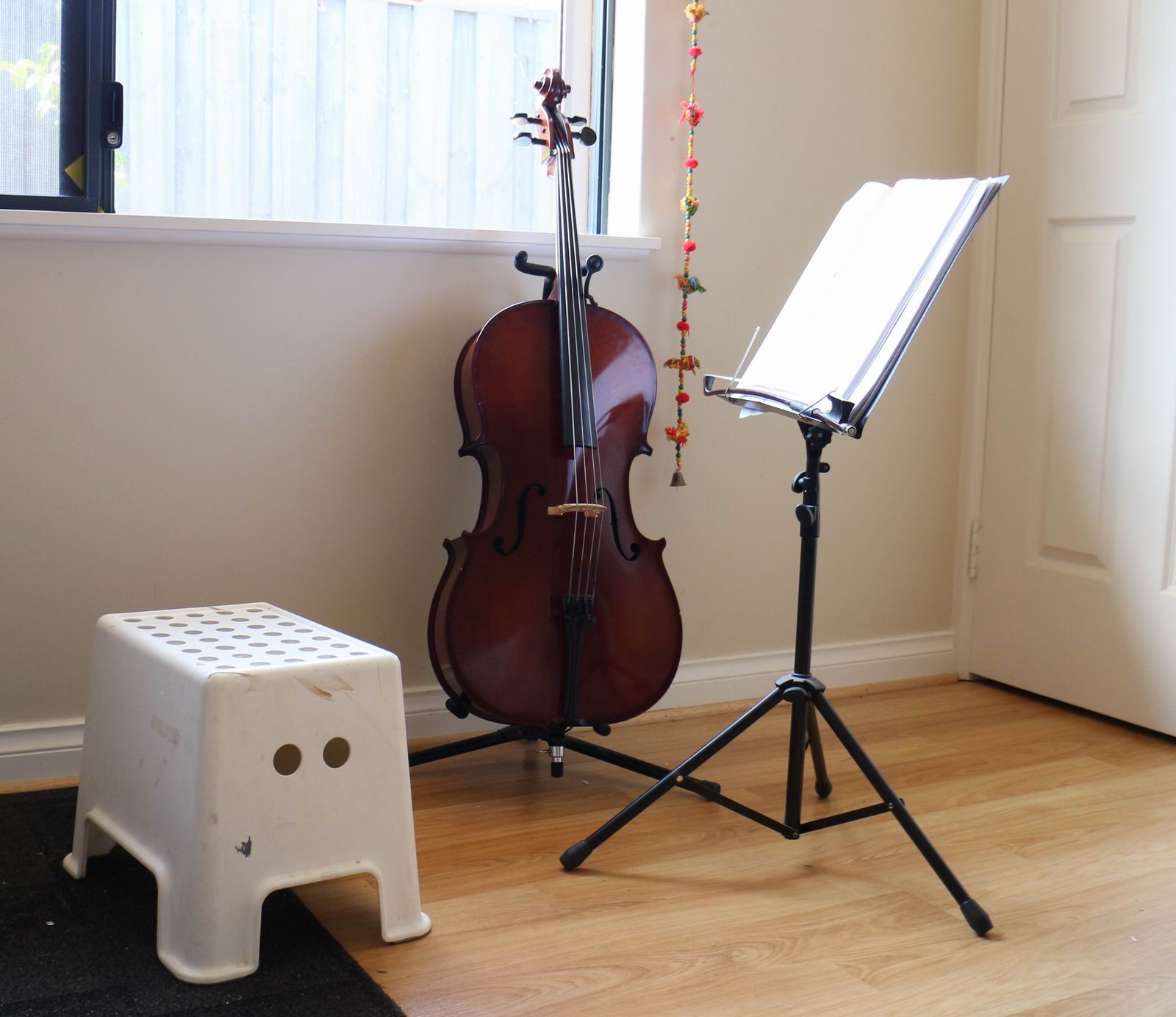
Do it. Instrument stand. My youngest daughter is learning the cello and look it's right there in her room, waiting for her, at all times. And it's made a difference, she plays it regularly, often without prompting!

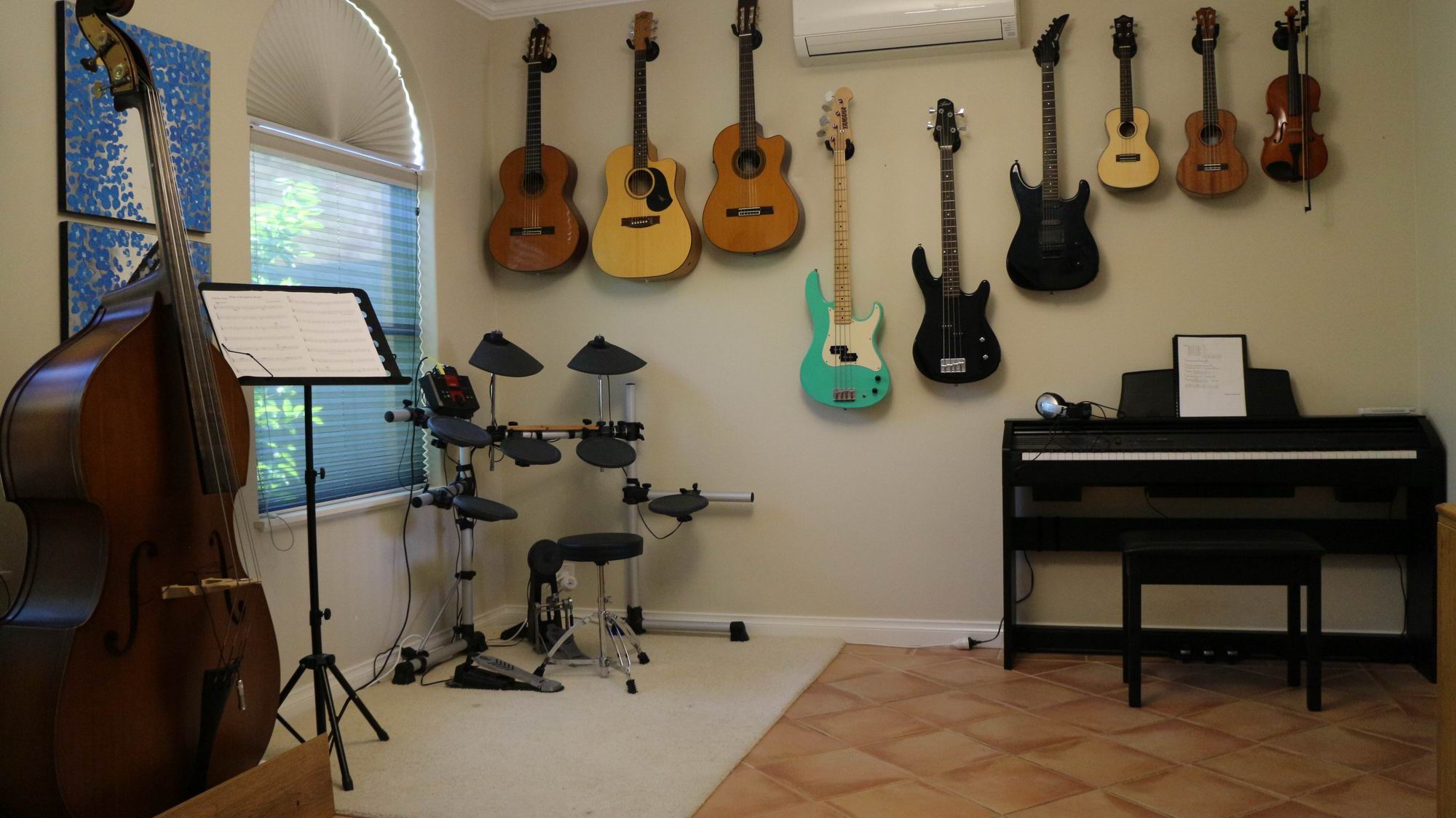
Now there are other options for easy access to your instrument. It's great to have one guitar on a stand somewhere handy, but when there are say 4 of them gathered into a room they take up a lot of space. I switched to wall mounting instruments, again, easily sourced online and very cheap. My wife likes the "look", they are still easy access, and the best part is you get floor space back. And how nice is it to sit in a calming room full of instruments. Good if you have an available room that is!

Friday, 25 August 2017

Rockin' with The Angels

Playing Aussie rock covers fits in well with a pub scene in Australia, I have a number I bring out but you can never have enough Aussie rock.  The Angels "Am I Ever Going to See Your Face Again?" is an absolute classic with it's MA+ call-response titular question, so it is obvious arrangement material. I had tried a few times over the years, but it hasn't been until now that I considered I had the skills to take it on.

It's pretty much all power chords, with that standard blues rock perfect fifth-major sixth rollicking riff underpinning everything, so that had to be prominent. In E, it's pretty easy, the bassline looks like this:

-2--2--4--2--2--2--4--2-
-0-----0-----0-----0----

That however uses up too much left hand, and is a real drag to do for long periods of time. It would be very difficult to put a melody over that. But since Drop D tuning has been my best friend for a long time now, the riff in Drop D will become:

-0--0--2--0--0--0--2--0-
-0-----0-----0-----0----

Much better!

The overall structure is a twelve bar blues chord progression so going from the E to the A means going up the neck rather than to the next strings, to keep the Drop D working, but that is fine.  I wanted to keep the key in E, so putting a capo on the second fret brought the Drop D back to E.

So now for the melody on top:

------------------------|------------
------------------------|------------
-------2-----0--------0-|------------
-------------------4----|----4-----0-
----0--2--0-----0--2--0-|----0--2--0-
-0-----0-----0-----0----|-0-----0----
       went  down  to san    ta    fe

Strumming the bass line would work to get the bass note on each beat and then the 5th-6th interval would be every 8th note, but I find strumming bass note chord fragments clumbsy. It might be the classical guitarist in me coming out - there are a few songs I play that I need to strum two or more bass strings, it forces your wrist down close against the soundboard to get the right angle, and this starts limiting what your fingers can do. You could train yourself to play fluently like that...or pluck the 5th string with alternating index-middle fingers.  Which is what I did.

And now, your annular (ring) finger can pluck the melody.  This is kinda hard, and the 4th string gets a lot of sympathetic vibration (and the odd accidental pluck) but it's completely in chord (the octave!) so it's okay.  I find I can't play right hand middle and annular fingers where the strings aren't next to each other, so my index finger gets busy on the riff when I'm picking the melody, but then reverts to index-middle when there's no melody.

You will have to mentally disconnect your ring finger because the melody is not on always on beat. The first three syllables "went down to" are all on beat, but "san ta fe" is all offbeat.  This is challenging, especially because the riff is always on-beat!  But, playing through slowly and then speeding up once you have made the mental adjustment does the trick.

It's another song that was a bit too rough for my youtube channel - too fast, bad picking - still needs work, but have a look, tell me what you think! :-)

Sunday, 20 August 2017

Why can't this be blog, again?

The last post of mine has created an unprecedented 3 comments so far, I'm inspired to keep posting works in progress. Ha ha, well I post as a cathartic release "I don't post because I want to, I post because I *have* to!"

When I sat down to record a few weeks back I rattled off five new arrangements, only two I deemed good enough to go on my youtube channel but the others weren't too bad so I'll keep posting them here. This song I talked about a year ago and I've been ticking it over from time to time in the background.

Arranging a song is one of those things were I get all excited and filled with euphoria when I begin, and once that addiction wears off, if I haven't finished it it falls in a hole.  But the sensible engineer in me says "You put in a lot of work, and there's only a bit more to go, finish it."  Which I duly ignore, but the sensible engineer never goes away: "You loved that arrangement when you started.  Find that love again, and finish it."

So this song is close to finished, but I didn't play it well enough this time to release it on my YouTube proper channel, it's still too rough. Sorry, the video and the audio goes out of sync, not sure what happened there (another reason to not post). Anyway, enough! Have a look already!

Monday, 14 August 2017

Playing in the white room

A few weeks ago I noticed Jake Reichbart had posted "White Room" by Cream which to me, is a pivotal quintessential psychedelic rock song harking from 1968.  Okay, my dad was heavy into Cream so this song was burned into my formative youth.

I was so impressed with Jake's cover I had to try it myself.  And much like the psychedelic nature of the song, I became addicted to his arrangement, like a drug, and stayed up late one night turning it over and over.  He plays it up the neck, I found it more at home in the open position.  By the time my fingers were hurting and I was really tired, I'd sussed out the main structure.  I have been playing it every few days to drill it in, it needs some variation so I'm not playing the same thing over and over again, but it's already kinda cool.

With that said, I have fallen further into the bad habit of playing sloppy, playing too hard, playing too fast, too much slapping...kinda the opposite of what a classical guitarist should be doing.  I'm happy enough with that but sometimes I think I need to scale it back and play something clean, accurate, and pure.  Or maybe it's time I go back to steel and dig in further...

Have a listen, I stepped from "White Room" into "Sunshine of Your Love", keeping the Cream feel, until I was disturbed; crashed and burned. Tell me what you think:

Wednesday, 5 July 2017

Yamaha CG-100A student guitar

The second guitar I bought for my students is a 1989 Yamaha CG-100A. I have a soft spot for old Yamaha classical guitars. This one was a level up from a student model, slightly better woods used and a glossier finish. A good clean up and fresh strings got it back to its original glory. As with the Musima I grabbed a few weeks ago, the more I played it the more it opened up.

The dimensions of both guitars are almost exactly the same down to the millimetre. I didn't realise there was such a standard for the shape of a classical guitar! The Musima is about 1mm narrower on the neck and the action is a bit lower so it's slightly easier to play. Both shall make good beginners guitars.

The Yamaha is Japanese specification but made in Taiwan, and the Musima is German...sooo Asia versus Euro :-) I had my wife listen as I played the same songs on both to see what she thought.

Results are Asia has a better bass, it felt like the bass was deep inside and not so much projecting out but booming from within like a subwoofer. It makes the guitar sound powerful, but muddy. Euro on the other hand has a mid and treble projection that leaps out of the guitar, but the bass is subdued. My Esteve on the other hand has clear trebles, mids and bass.

But don't take my word for it, have a listen! All captured exactly the same on my Zoom H1, unproceeded, all guitars wearing brand new D'Addario EJ45 strings

Musima 130:
Yamaha CG-100A:
Esteve 1GR11:

So, next stop, see if I can teach two twelve year old girls how to play some classical guitar!

Sunday, 2 July 2017

Fender FM212R amplifier debugging

I do some volunteer work for the school music program, mostly easy stuff like restringing guitars, but I was asked if I could fix an amp. "I'll have a look at it." I didn't live to regret saying it, but it really pushed the limits of what I am capable of.

It's a Fender Frontman FM212R, the last of the Fender analogue amps. Analogue as in it is full of transistors and resistors and capacitors and not a single digital chip inside it. There are always going to be analogue circuitry in an amp, but most amps these days use digital processing for any effects like reverb and drive.

Straight up some potentiometers were noisy. As in, as you twist a knob, there are crackles and hiss and thumps and it's pretty awful. This happens a lot, behind each knob is a potentiometer that generally has a carbon film with a mechanical "wiper" that sweeps across the surface changing the effective resistance. Crackles when there is dust and any other crud building up on the carbon surface. They aren't sealed, so buy a can of electronics "Contact cleaner" that come with a thin straw and squirt some inside the potentiometer (there are generally a few access points) and twist the shaft a lot, most of the time they come good. If they don't it's probably because the carbon film is worn down, in that case, replace them.

I ended up replacing 4 of them, now be careful, some pots are "linear" and some are "logarithmic". Generally, if it is "A" that means it is logarithmic. "B" means linear. This has not always been the case, when in doubt check! A linear pot, when half twisted, will be half way through its resistance. For example an A10k half twisted will be at 5k resistance, whereas a logarithmic will be a lot less than that. Why? It's how our ears work, you generally have to double anything to make it sound twice as loud. If you used a linear pot you'd be at half volume by about position 3, and the difference between say 9 and 10, being maximum volume, you wouldn't hear any difference. Generally, people want to hear an audible difference between volume 9 and volume 10.

Anyway, that was the easy part. The hard part was that the amplifier was distorting.

To diagnose this you need a schematic diagram of the circuit, an oscilloscope to monitor what is going on in the circuit while it is operating, and say an electronic engineering degree and/or several years of experience debugging analogue circuits. I managed to find the schematic circuit (last seen here: http://www.nodevice.com/manual/fm212r/get126250.html), source an oscilloscope, and I do have an electronic engineering degree but was quite lacking in analogue circuit debugging. But I do like trying!

The way to approach this is to inject a waveform into the amplifier, and then use the oscilloscope to check what the amplifier is doing as the signal travels through the circuit. Injecting a waveform is as simple as plugging in your guitar and sounding a note - but what you really want is a continuous signal. I did this with my laptop, an online signal generating website, and a cable from the laptop headphones to the amp. Let me tell you how sick I am of a 440Hz sinewave. I mixed it up from time to time, changing the frequencies, but man, constant pitch is truly awful.

Now a fixed frequency sine wave doesn't tell you the full story - if the amplifier is failing only in different frequency ranges, you might not see the problem. Square waves are great, (insert engineering discussion), they contain all frequencies. The problem is when I injected a square wave and observed the output, it didn't match the square wave at all! This is to be expected as a guitar amp doesn't have to reproduce a square wave. So it's hard to tell what's right and what's wrong.

But I was in luck. The problem did show at lower frequiencies of sine wave. Not easy to hear, but easy to see on the oscilloscope. You can see in the photo the yellow input sine wave is distorted in the blue output signal (click to zoom). Moving slowly through the circuit, comparing the input signal against the output signal, I found the section of the circuit where the problem. Which was a big section of many transistors, diodes, resistors, and, well, it helped but I couldn't say "it's that part!"

I did some of the basics first - I resoldered a big area of that circuit, in case any of the components had a dry joint. I poked components with a wooden chopstick while it was operating to see it it made a change. No. The distortion sort of came and went, sometimes the amp would play fine. This is the worst sort of problem you can come across; intermittent failures.

I decided that it must be a heat issue. So, with a heatgun (I could have used a can of cold spray, but heatgun was easier) I pointed heat at small sections of the circuit board and watched the output on the oscilloscope. Eureka! A bunch of diodes very clearly showed the distortion changing with heat!

Did I mention I am an electronics engineer? I haven't done electronics for a living for 20 years, but I recognised the signal diodes as the crossover biasing diodes for the class AB amplifier stage. Quick summary - class B amps have matching complementary transistors (or FETs) that deal with half the load each, and the crossover between the transistors creates distortion, so class AB introduces diodes to pre-bias the transistor pair eliminating the distortion.

There was also a diode that I didn't recognise the function of, some sort of signal feedback from a later stage I'm guessing, sadly it was a different sort of diode to the rest being able to take a much higher voltage drop. I couldn't tell which of the 4 were the problem, so I ordered some of each online. You could only buy the diodes in packs of 200, but at $14 delivered for 400 diodes it's not really a problem.

Since a class AB amplifier has a symmetry, I also decided to replace the other set of diodes, even though they weren't showing a problem. As a minimum, the new diodes will be more balanced than a new one and an old one, or, if they failed on one side of the amplifier symmetry it was likely they may fail on the other side too.

I desoldered the diodes and popped the new ones in. Couldn't believe it, problem solved. Played through the amp for at least an hour, perfect.

Let me tell you, I was well pleased with myself, I nearly gave up a few times, it took me two months of stuffing around from time to time on it, trying to keep myself encouraged. On the day I sent it back to the music teacher I said "don't put it into production until you have rebuilt some confidence in it." And here's the difference between a cautious engineer and a music teacher - that very same day he put it into an evening concert...